Possible Causes
A right seat belt buckle switch short to battery fault could be caused by damaged wiring, terminals, connectors or a faulty RCM.
- Check for hard or intermittent DTC
Turn ignition switch to OFF position. Connect scan tool to Data Link Connector (DLC). See USING SCAN TOOL under DIAGNOSTICS. Turn ignition switch to RUN position. Retrieve and record any continuous DTCs. See RETRIEVING FAULT CODES under DIAGNOSTICS. Perform on-demand self-test. See ON-DEMAND SELF-TEST under DIAGNOSTICS. If DTC B2437 was retrieved during on-demand self-test, fault is hard. Go to next step. If DTC B2437 was not retrieved, fault is intermittent. Go to step 5 . - Check circuit for short to battery between right front seat & RCM
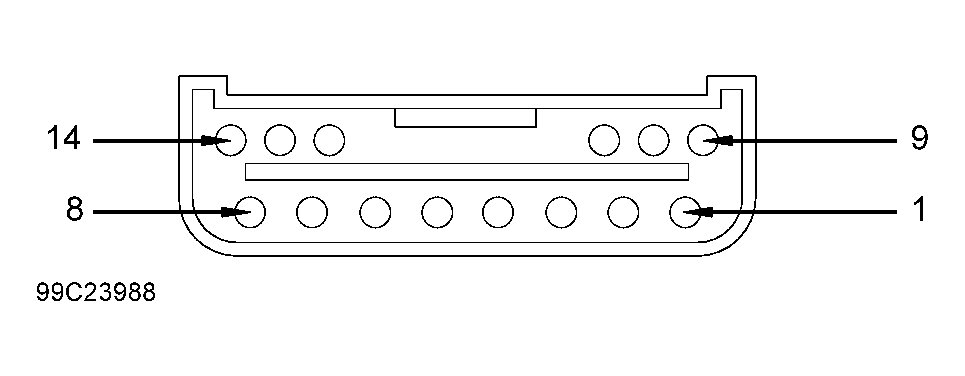
Turn ignition switch to OFF position. Disable air bag system. See DISABLING SYSTEM under DISABLING & ACTIVATING AIR BAG SYSTEM. Access RCM and disconnect connector C310A. See RESTRAINTS CONTROL MODULE under REMOVAL & INSTALLATION. Disconnect right front seat floor connector C312. Turn ignition switch to RUN position. Measure voltage between ground and vehicle harness side of right seat floor connector C312, terminal No. 10 (Red/Black wire, circuit No. 1514). See Figure . Measure voltage between ground and vehicle harness side of right seat floor connector C312, terminal No. 1 (Tan/Black wire, circuit No. 1558). If voltage is less than 0.2 volt in both circuits, go to next step. If voltage is more than 0.2 volt in either circuit, repair short to battery in appropriate wire. See WIRING DIAGRAMS . Go to step 6 . - Check circuit for short to battery between right front seat belt buckle switch & RCM
Turn ignition switch to OFF position. Reconnect right seat floor connector C312. Disconnect right seat belt buckle switch connector. Turn ignition switch to RUN position. Measure voltage in Tan/Black wire between ground and harness side of right seat belt switch harness connector. Measure voltage in Red/Black wire between ground and harness side of right seat belt switch harness connector. If voltage is less than 0.2 volt in both circuits, go to next step. If voltage is more than 0.2 volt in either circuit, repair short to battery in appropriate wire. Go to step 6 .NOTE: Ensure all air bag system simulators, sensor electrical connectors and RCM electrical connectors are connected prior to carrying out on-demand self-test or erroneous faults may be set. - Confirm RCM Fault
Turn ignition switch to OFF position. Reconnect RCM connector C310A. Reconnect right front seat belt buckle connector. Turn ignition switch to RUN position. Perform on-demand self-test. If DTC B2437 was retrieved during on-demand self-test, replace RCM. Go to step 6 . If DTC B2437 was not retrieved during on-demand self-test, fault is corrected. Go to step 6 . - Check for intermittent fault
Turn ignition switch to OFF position. Disable air bag system. See DISABLING SYSTEM under DISABLING & ACTIVATING AIR BAG SYSTEM. Perform on-demand self-test. If DTC B2437 was retrieved during on-demand self-test, go to step 2 . If DTC B2437 was not retrieved during on-demand self-test, check for cause of intermittent fault. Attempt to recreate fault by flexing wire harness and cycling ignition switch frequently. Repair any intermittent problems found. Go to next step. - Check for additional DTCs
Refer to continuous DTCs recorded in step 1 . If any continuous DTCs were retrieved, go to diagnostic trouble code identification table for direction to appropriate test. See DIAGNOSTIC TROUBLE CODE IDENTIFICATION table. DO NOT clear any DTCs until all DTCs have been resolved. If no DTCs were retrieved, reconnect air bag system. Activate air bag system. See ACTIVATING SYSTEM under DISABLING & ACTIVATING AIR BAG SYSTEM. Clear all DTCs. See CLEARING FAULT CODES under DIAGNOSTICS.