A/C System Filtering (Except Focus & Villager)
WARNING:
Before performing filtering procedures, review USING R-134a REFRIGERANT .
CAUTION:
An A/C refrigerant analyzer must be used before recovery of any vehicles A/C refrigerant. Failure to do so puts the shops bulk refrigerant at risk of contamination. All contaminated A/C refrigerant must be disposed of as hazardous waste. For all equipment, follow equipment manufacturers procedures and instructions.
CAUTION:
On vehicles being serviced for an internal compressor or desiccant failure, a NEW suction accumulator/drier, muffler, thermal expansion valve and evaporator core orifice must be installed prior to filtering A/C system. Internal plumbing of these devices makes it impossible to correctly remove any residual agent. These components are typically discarded after A/C system contamination. Hoses can normally be reused unless they are clogged with foreign material. The filter is intended for use on one vehicle only.
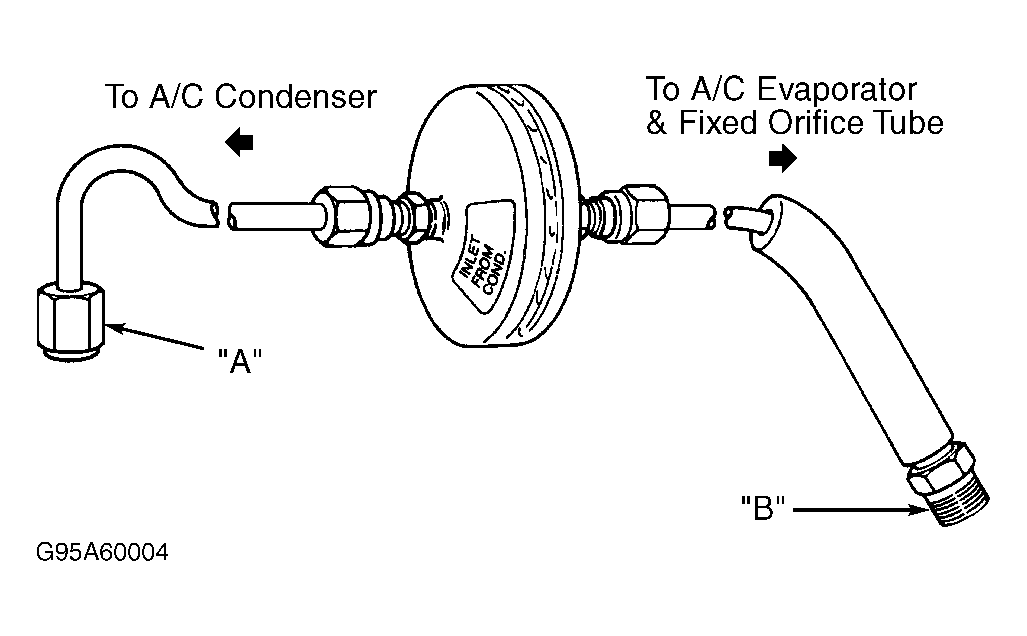
- Orient filter inlet toward A/C condenser core.
- Temporarily install pancake filter between A/C condenser core and condenser to evaporator tube. See Figure. Use flexible refrigerant hose of 2500 psi (17,238 kPa) burst rating. Make connections using A/C test fitting set.
- Lubricate refrigerant system with correct amount of clean PAG oil. See SPECIFICATIONS in appropriate MANUAL A/C HEATER SYSTEMS or AUTOMATIC A/C HEATER SYSTEMS article.
- Evacuate and charge refrigerant system. See FORD MOTOR CO. under RECOVERY/EVACUATION & RECHARGING.
- Check all refrigerant system hoses, lines and position of newly installed filters to ensure they do not interfere with other engine compartment components. If necessary, use tie straps to make adjustments.
- Provide adequate airflow to front of vehicle (with a fan, if necessary). Select A/C operation and set blower motor speed to maximum. Start engine and let it idle briefly. Ensure A/C system is operating correctly.
- Gradually increase engine speed to 1200 RPM by running it at lower RPM for short periods (first at 800 RPM, then at 1000 RPM). Set engine at 1200 RPM and run it for one hour with A/C system operating.
- Stop engine.
- Recover refrigerant. See FORD MOTOR CO. under RECOVERY/EVACUATION & RECHARGING.
- Remove fittings, flexible hoses and pancake filter from between condenser and condenser to evaporator tube.
- Discard pancake filter. It can be used one time only.
- Reconnect condenser to evaporator tube to A/C condenser core.
- Evacuate, charge and leak-test refrigerant system. See FORD MOTOR CO. under RECOVERY/EVACUATION & RECHARGING.
NOTE:
The pancake filter is not permanently installed and will be removed at end of this procedure.