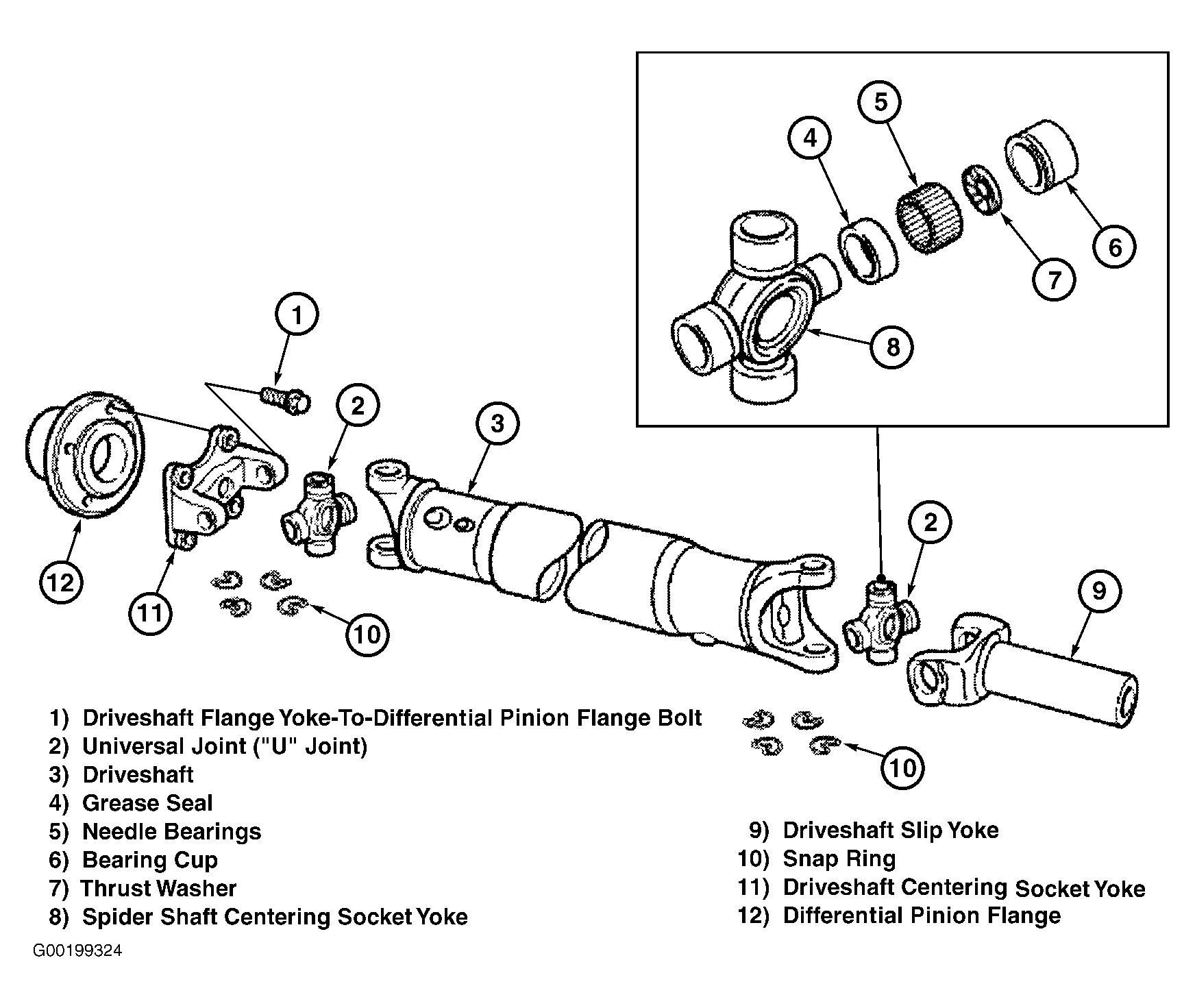
Drive Shafts: Description
The driveline transfers the engine torque through the drive shaft to the axle. The rear drive shaft is connected to the output shaft of the transmission by a slip yoke and to the differential by a drive shaft centering socket yoke. See Fig 1 . Universal joints ("U" joints), are used at both ends of the drive shaft to allow for angular motions.
A slip yoke is used to allow for any changes to the length of the drive shaft. The engine torque enters the axle through the drive pinion, which rotates the ring gear.
All drive shaft assemblies are balanced. If the vehicle is to be undercoated, cover the drive shaft assembly to prevent overspray of any undercoating material. The drive shaft has the following features:
- A tubular shaft used to transfer torque from the engine, through the transmission to the ring and pinion in the rear axle, which transmits the torque to the wheels.
- Consists of 2 single cardan "U" joints, a drive shaft slip yoke and a drive shaft centering socket yoke.
- The splined slip yoke permits the drive shaft to move forward and rearward on the transmission output shaft during drivetrain movement.