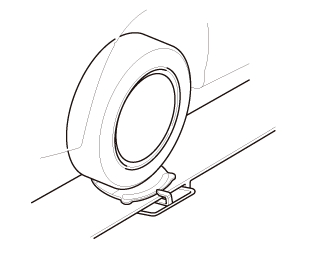
Inspection Procedure
Use commercially available computerized four wheel alignment equipment to measure wheel alignment (caster, camber, toe, and turning angle). Follow the equipment manufacturer's instructions.
- 1. Caster - Inspect
1. Check the caster angle.
Except USA and Canada models (2WD) Caster angle: Without 16 inch wheels: 2 ° 44 ' ±30 ' With 16 inch wheels: 2 ° 39 ' ±30 ' (Maximum difference between the right and left side: 0 ° 30 ') USA and Canada models (2WD) Caster angle: Without 16 inch wheels: 2 ° 50 ' ±30 ' With 16 inch wheels: 2 ° 44 ' ±30 ' (Maximum difference between the right and left side: 0 ° 30 ') - If the measurement is within specifications, measure the front camber angle.
- If the measurement is not within specifications, check for bent or damaged suspension components.
- 2. Camber - Inspect
1. Check the camber angle.
Front
Except USA and Canada models (2WD) Camber angle: Without 16 inch wheels: -0 ° 30 ' ±45 ' With 16 inch wheels: -0 ° 40 ' ±45 ' (Maximum difference between the right and left side: 0 ° 45 ') Front
USA and Canada models (2WD) Camber angle: Without 16 inch wheels: -0 ° 40 ' ±45 ' With 16 inch wheels: -0 ° 10 ' ±45 ' (Maximum difference between the right and left side: 0 ° 45 ') Rear
Except USA and Canada models (2WD) Camber angle: Without 16 inch wheels: -1 ° 00 ' ±45 ' With 16 inch wheels: -1 ° 14 ' ±45 ' (Maximum difference between the right and left side: 0 ° 45 ') Rear
USA and Canada models (2WD) Camber angle: Without 16 inch wheels: -1 ° 14 ' ±45 ' With 16 inch wheels: -1 ° 04 ' ±45 ' (Maximum difference between the right and left side: 0 ° 45 ') - If the measurement is within specification, measure the toe-in.
- If the measurement is not within specification, check for bent or damaged suspension components.
- 3. Rear Toe - Inspect
NOTE: Do the rear toe inspection before the front toe inspection.
1. Release the parking brake to avoid an incorrect measurement
2. Check the toe.
Rear toe-in: 2 ± 2 mm (0.08 ± 0.08 in) - If adjustment is required, go to rear toe adjustment.
- If no adjustment is required, go to front toe inspection.
- 4. Front Toe - Inspect
NOTE: Do the rear toe inspection before the front toe inspection.
1. Set the steering column to the middle tilt position and telescopic position
2. Center the steering wheel spokes, and hold it
3. Check the toe with the wheels pointed straight ahead.
Front toe-in: 0±2 mm (0±0.08 in) - If adjustment is required, go to the front toe adjustment.
- If no adjustment is required, remove the alignment equipment.
- 5. Turning Angle - Inspect
1. Turn the wheel right and left while applying the brake, and measure the turning angle of both wheels.
Except USA and Canada models (2WD) Turning angle: Inward: Without 16 inch wheels: 36 ° 42 ' ±2 ° With 16 inch wheels: 36 ° 36 ' ±2 ° Outward (reference): Without 16 inch wheels: 31 ° 18 ' With 16 inch wheels: 31 ° 30 ' USA and Canada models (2WD) Turning angle: Inward: 36 ° 30 ' ±2 ° Outward (reference): Without 16 inch wheels: 31 ° 06 ' With 16 inch wheels: 31 ° 24 ' 2. If the measurement is not within specifications, even up both sides of the tie-rod threaded section length while adjusting the front toe. If it is correct, but the turning angle is not within the specifications, check for bent or damaged suspension components.