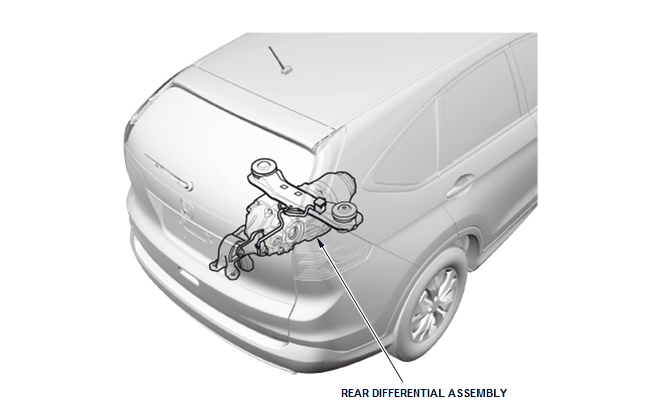
Rear Differential System Description - 4WD System (4WD)
Overview
The dual pump system (DPS) has a real-time control mechanism that allows most of the driving force to go to the front wheels and transmits an appropriate driving force from the front wheels to the rear wheels when needed. The rear differential assembly has an integrated oil-bath clutch and differential mechanism inside and a light and compact cam mechanism.
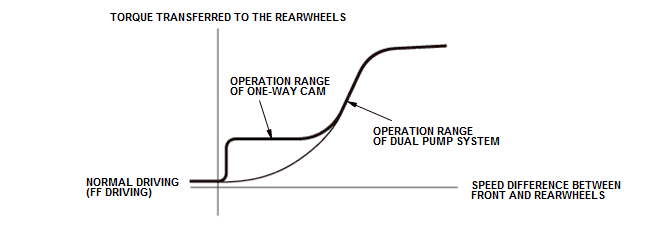
The DPS controls the front wheels and rear wheels differently depending on the difference between the rotational speeds of the wheels. When the speed difference is small, the one-way cam is working to minimize the need for the pump to produce hydraulic pressure. When the speed difference is large, hydraulic pressure develops in the two pumps. By controlling the engagement of the main clutch, driving force transmitted to the rear wheels is optimized according to the driving conditions. This system switches to 2-wheel drive (2WD) or 4-wheel drive (4WD) automatically so the driver does not have to select these modes manually. The DPS has a limiter switch to prevent transmission of excessive torque to the rear wheels. For the differential fluid, DPSF-II is used exclusively.
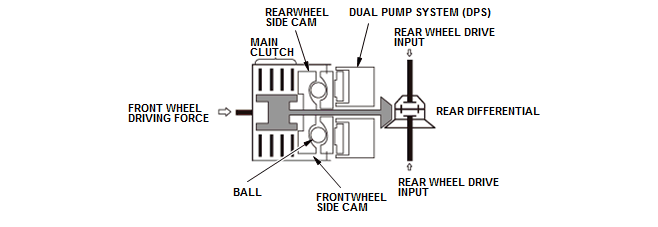
One-way Cam Operation
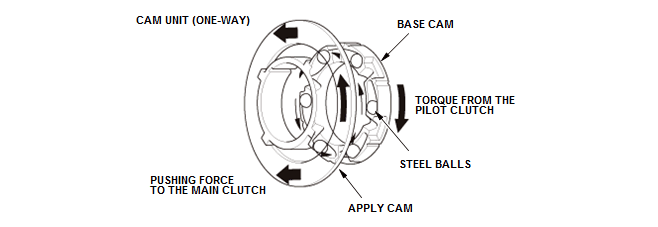
The one-way cam unit consists of two cams (front wheel and rear wheel) and balls between the two cams which detects the difference in the front and rear wheel speeds. When a difference of the front and rear wheel speeds develops, the difference in the rotational speed of the two cams also develops, and the front cam rotational speed exceeds that of the rear cam. When this happens, the balls move along the cam groove, pushes and widens the cams, and applies pressure to the main clutch. When the speed difference becomes greater, the dual pump system (DPS) operates. Since the cam unit is a one-way type, it only operates when driving forward.
NORMAL DRIVING
CAM UNIT OPERATION
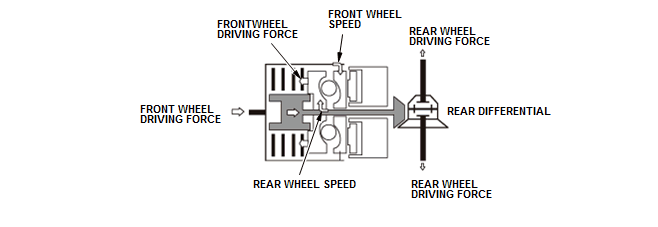
CAM UNIT OPERATION
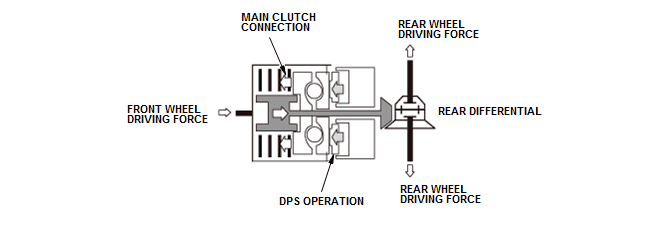
Dual Pump System (DPS) Operation
For non-slippery roads (no slipping): DPS not operating
When the front and the rear wheel speeds are equal (no slipping) as from normal driving, the oil discharged in the front pump and the oil drawn in the rear pump are equal, so the hydraulic pressure that pushes the wet-type multi-plate clutch is not developed, and the rear wheels are not driven.
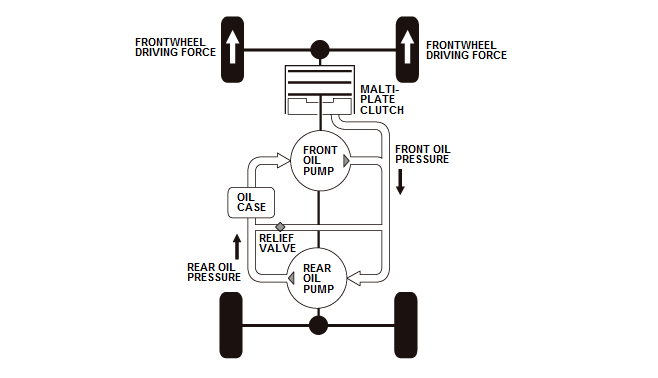
In addition, the clutch drum and the clutch hub are not contacted completely, but linked each other with a maximum of 80% of contacting rate. This slippage reduces the friction caused by a rotating difference between the front and rear.
For slippery roads (with slipping): DPS operating
When the front wheel speed is more than the rear wheel speed such as in starting, acceleration, and driving on a slippery road surface, the amount of oil discharged by the front pump exceeds the oil drawn by the rear pump, thus producing hydraulic pressure that engages the wet-type multi-plate clutch, and transmits driving force to the rear wheels. When the speed of the front wheels becomes even greater than the rear wheels, the torque limiter mechanism (relief valve) limits the hydraulic pressure that engages the wet-type multi-plate clutch, and transmits only the necessary driving force to the rear wheels as needed by 4WD driving.
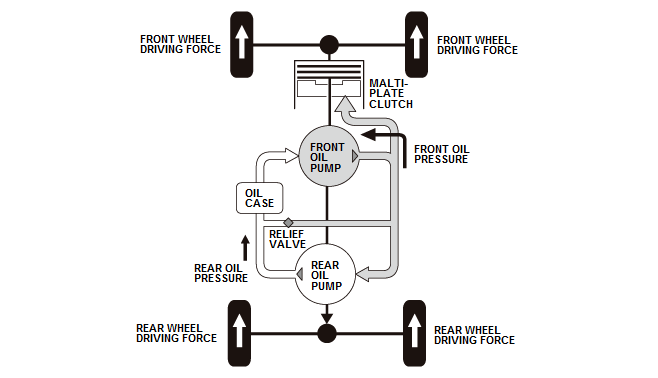
In addition, the clutch drum and the clutch hub are not contacted completely, but linked each other with a maximum of 80% of contacting rate. This slippage reduces the friction caused by a rotating difference between the front and rear.
Rear Differential Assembly
The rear differential assembly consists of the torque control differential (TCD) that controls the 4WD mechanism and the rear differential mechanism section.
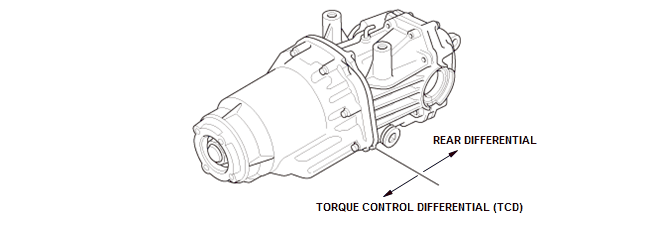
Torque control differential (TCD)
The TCD consists of the TCD case, the differential assembly, the clutch, the one-way cam, and the oil pump body assembly.
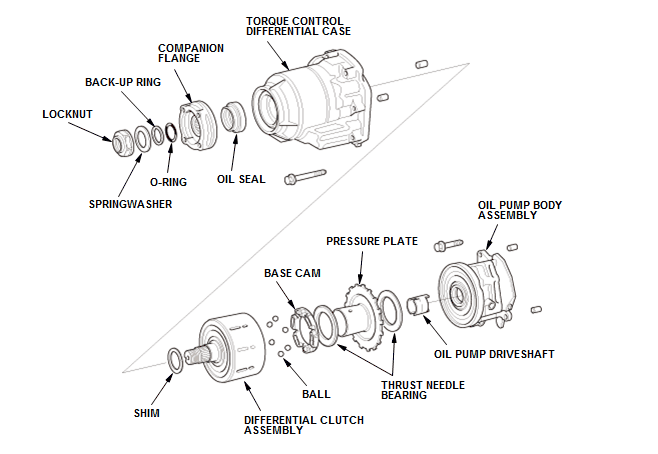
Differential clutch assembly
The differential clutch assembly is composed of the clutch guide, clutch disc A/B, the clutch hub, the pressure plate, and also the one-way cam, the pilot clutch assembly, and other parts. The clutch guide gets the front wheel driving force from the propeller shaft, while the clutch hub meshes with the hypoid drive pinion gear, and follows the speed of the rear wheels.
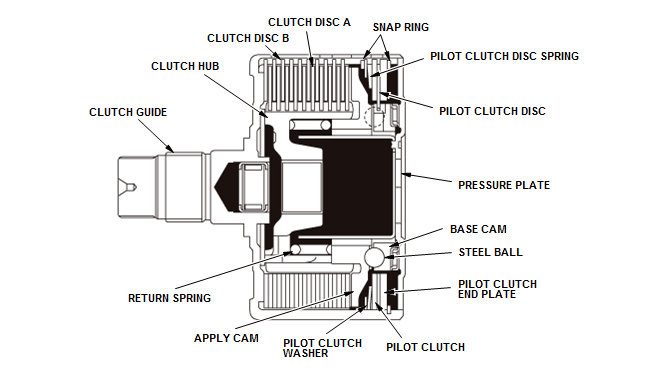
One-way cam
The one-way cam consists of the base cam that spins with the clutch guide via the pilot clutch, the apply cam that meshes with the clutch hub, and the steel balls that are sandwiched by the two cams. The base cam rotates at front wheel speed and the apply cam rotates at rear wheel speed. When speed difference develops, the steel balls move along the grooves in the base cam, and by the shape of the grooves, pushes the apply cam outwards.
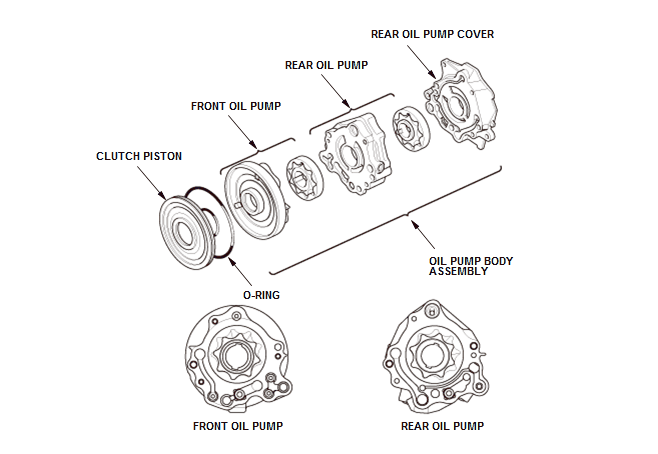
Pump body assembly
The pump body assembly consists of the front oil pump, the rear oil pump, and the rear oil pump cover, all with a built-in hydraulic circuit. The front oil pump is driven by the pressure plate component. The rear oil pump is driven by the hypoid drive pinion gear. The front and rear are both trochoidal pumps. By design, the rear oil pump capacity is set 2.5 % higher than the front oil pump capacity, this is to compensate for the speed difference caused by wear in the front tires, as well as for tight corner braking.
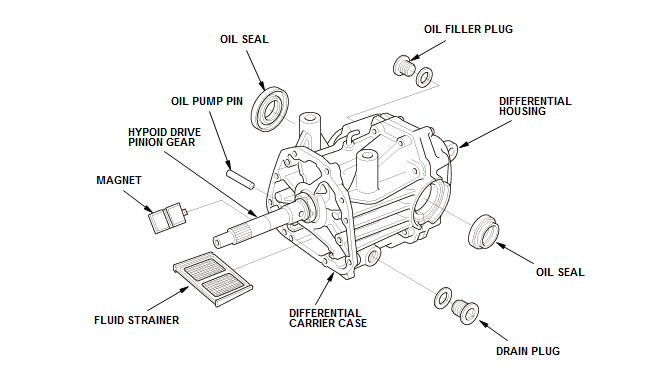
Differential carrier
This is composed of the hypoid drive pinion gear, the hypoid ring gear, the differential housing, and other parts.
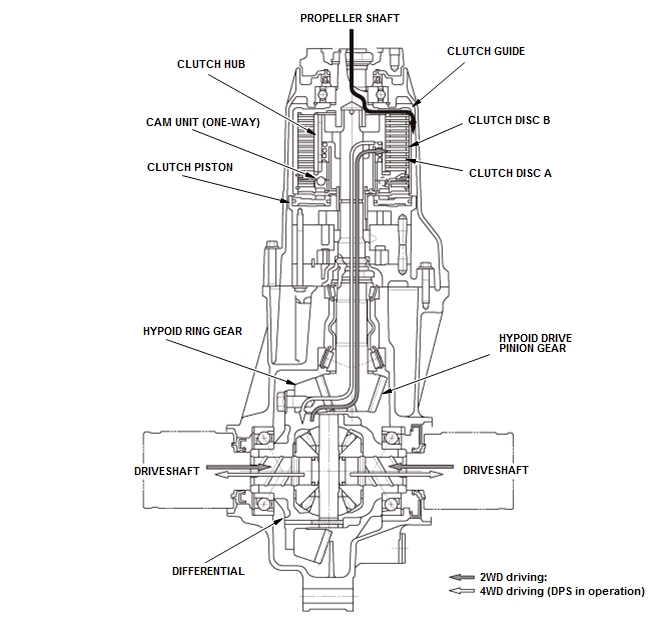
Power Transmission
During 2WD driving (DPS not in operation)
In addition, the clutch drum and the clutch hub are not contacted completely, but linked each other with a maximum of 80% of contacting rate. This slippage reduces the friction caused by a rotating difference between the front and rear.
During 4WD driving (DPS operation)
The front wheel driving force from the propeller shaft is transmitted to the clutch guide and the clutch plate. When the oneway cam operates, the clutch plate and the clutch disc become connected, and from the clutch hub, the driving force is transmitted to the pinion gear, the ring gear, the differential, the rear driveshafts, and to the rear wheels.
Hydraulic Circuit
Construction of the hydraulic circuit
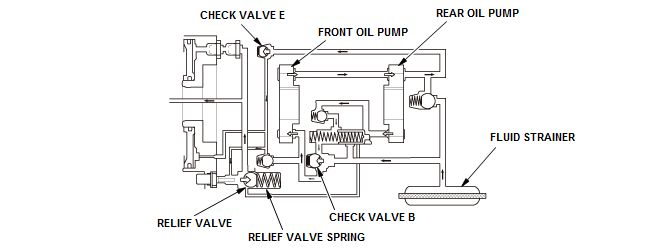
Built inside the oil pump assembly, the hydraulic circuit provides clutch assembly lubrication together with 4WD control. The hydraulic circuit consists of the front and rear oil pumps, the front valve and five check valves for hydraulic route switching, the choke section which is the hydraulic path to the clutch piston compartment, and the two orifices that controls the hydraulic pressure in the piston compartment. The hydraulic circuit is equipped with a system protection function with a wax-pellet-style thermal switch and relief valve.
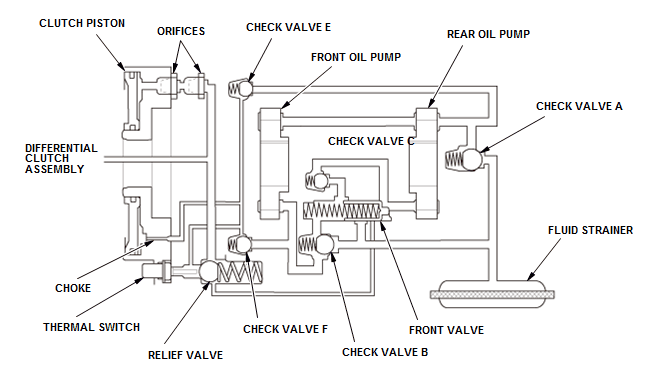
| Part Name | Function |
|---|---|
| Front oil pump | Rotates at the front wheel speed, is driven via the propeller shaft, and produces hydraulic pressure. |
| Rear oil pump | Rotates at the rear wheel speed, is driven by the hypoid pinion gear, and produces hydraulic pressure. |
| Front valve | Bypasses the hydraulic pressure produced in the rear oil pump to the clutch assembly and the front oil pump. In normal 2WD driving, it operates during deceleration. |
| Check valves A, B | Secure hydraulic path from the oil strainer to the oil pump. |
| Check valve C | Bypasses the front oil pump discharging pressure to the rear oil pump when switching to 4WD. |
| Check valves E, F | Bypass the oil pump discharging pressure to the clutch piston compartment when switching to 4WD. |
| Choke | A hydraulic path that sends the hydraulic pressure from the oil pump to the clutch piston compartment. |
| Orifice | Adjusts the hydraulic pressure in the clutch piston compartment. |
| Relief valve | Operates when the hydraulic pressure to the clutch piston exceeds the set pressure in the relief valve, and releases hydraulic pressure to the piston compartment. |
| Thermal switch | Operates when the differential oil becomes hot, and forces the relief valve to open. |
Operation of the hydraulic pressure circuit
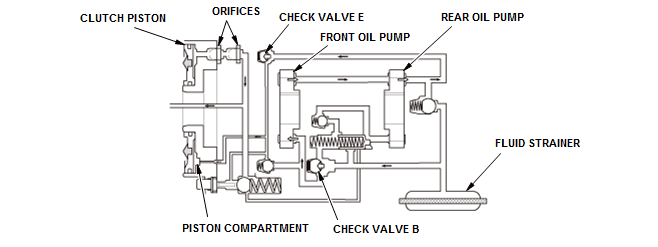
1. Forward starting and acceleration (4WD)
- 1. When the front wheel speed exceeds that of the rear wheel speed during forward starting and acceleration, and driving on slippery roads, the front oil pump speed exceeds that of the rear oil pump, thus producing hydraulic pressure.
- 2. The oil drawn in by the front oil pump from the fluid strainer, passes through check valve B, and is drawn in or discharged.
- 3. Oil discharged from the front oil pump is drawn in by the rear oil pump. However, when the drawing capacity of the rear oil pump is exceeded, the excess oil passes check valve E, which is pumped to the piston compartment, pushes the clutch piston to connect it to the clutch assembly, and transmits driving force to the rear wheels.
- 4. Oil in the piston compartment is adjusted by the two orifices. Oil that passes through the orifices lubricates and cools the clutch assembly interior and the hypoid pinion gear shaft.
2. Forward driving at constant speed (2WD)
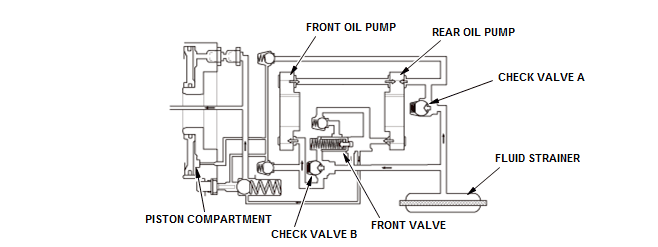
- 1. When driving forward at a constant speed, the rotation speeds of the front and rear wheels are equal, thus there is no speed difference between the front and rear oil pumps.
- 2. Oil discharged from the front oil pump is drawn in by the rear oil pump, and the oil discharged from the rear oil pump is again drawn in by the front oil pump. The oil circulates only between these two oil pumps. Since hydraulic pressure does not develop in the piston compartment, the clutch assembly is not connected, and rear wheel drive is not engaged.
3. Forward deceleration (2WD)
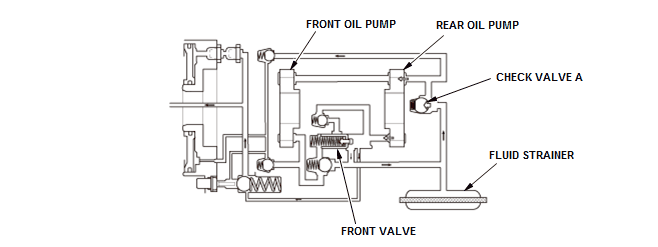
- 1. During forward deceleration, the rear wheel speeds exceeds the front wheel speed because of braking characteristics, and the rear oil pump speed exceeds the front oil pump speed.
- 2. The oil drawn in by the rear oil pump from the fluid strainer, passes through check valve A, and is drawn in or discharged.
- 3. Oil discharged from the rear oil pump is again drawn in by the rear oil pump, and is circulated. Because of this, the piston compartment does not produce hydraulic pressure, so that the clutch assembly is not connected, and rear wheel drive is not engaged.
4. Reverse starting and deceleration (4WD)
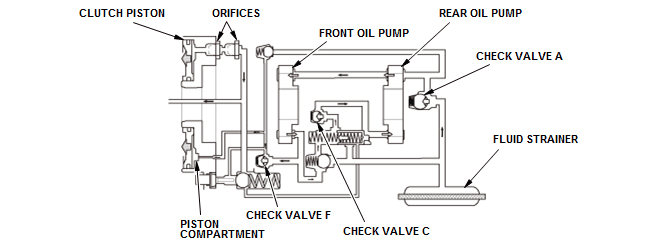
- 1. When the front wheel speed exceeds that of the rear wheel speed during reverse starting and acceleration, or when driving on slippery roads, the front oil pump speed exceeds that of the rear oil pump, thus producing hydraulic pressure.
- 2. During reverse driving, the oil pumps rotate in reverse. However, the oil drawn in by the front pump from the fluid strainer passes check valve A and the rear oil pump, and then is drawn in and discharged by the front oil pump.
- 3. Oil discharged by the front oil pump exceeds the drawing capacity of the rear oil pump, passes through check valve F, travels to the piston compartment, and is pressure-regulated in the two orifices.
- 4. Hydraulic pressure pushes the clutch piston to connect it with the clutch assembly interior, and via the propeller shaft, transmits driving force from the transmission to the rear wheels.
5. Reverse driving at constant speed (2WD)
- 1. When reverse driving is at a constant speed, the front and rear wheel speeds are equal, so that no speed difference exists between the front and rear oil pumps.
- 2. When reverse driving, the oil pumps rotate in reverse. However, the oil discharged from the front oil pump is drawn in by the rear oil pump. Likewise, the oil discharged by the rear oil pump is again drawn in by the front oil pump, and is circulated.
- 3. The excess oil coming from the difference in capacity of the front and rear oil pumps, although in small amounts, passes through check valve E and goes to the piston compartment. However, the hydraulic pressure is low so that the clutch piston is not moved, and rear wheel drive is not engaged.
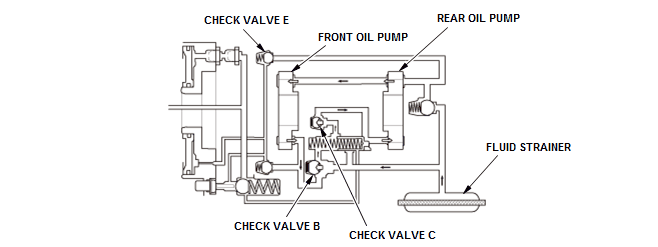
6. Reverse deceleration (4WD)
- 1. During reverse deceleration, the rear wheel speed exceeds the front wheel speed because of braking characteristics, thus causing the rear oil pump speed to exceed the front oil pump speed.
- 2. During reverse driving, the oil pump rotates in reverse, but the rear oil pump draws in oil from the fluid strainer. The oil pump passes through check valves B and C, and is drawn in by the rear oil pump.
- 3. Excess oil from the oil discharged from the rear oil pump exceeds the drawing capacity in the front oil pump, passes through check valve E, travels to the piston compartment, and is pressure-regulated at the two orifices.
- 4. Hydraulic pressure presses the clutch piston to connect with the clutch assembly interior, and transmits driving force from the transmission to the rear wheels via the propeller shaft.
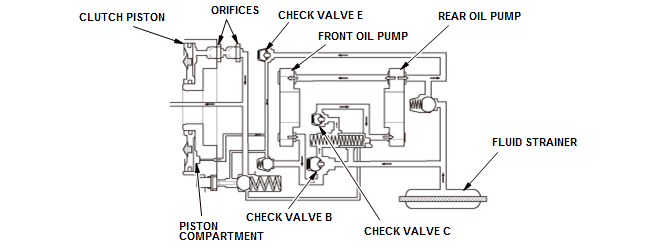
Operation of the emergency hydraulic pressure circuit
Thermal switch operation
- -1.
During 4WD driving, adjusted oil acts on the relief valve and the clutch piston.
- -2.
When the differential oil becomes abnormally hot, the thermal switch pushes the check valve, and the hydraulic pressure in the clutch piston is released, so that 4WD is disabled to protect the system.
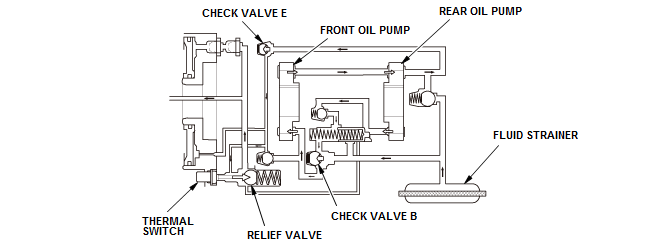
When the relief valve is in operation
- -1.
During 4WD, adjusted oil acts on the relief valve and the clutch piston.
- -2.
When hydraulic pressure exceeds the spring tension at the release spring, the check valve opens, the oil pressure in clutch piston is maintained, and excessive torque input to the rear wheel drive system is prevented.