Exterior Lights System Description - Control/Function
Headlights Function
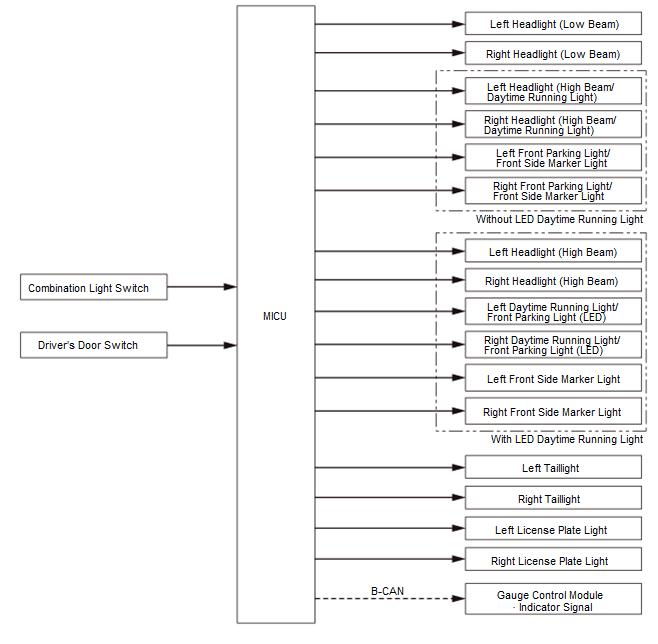
The headlights are controlled by the MICU, based on combination light switch input signals.
Headlights Auto-OFF Function
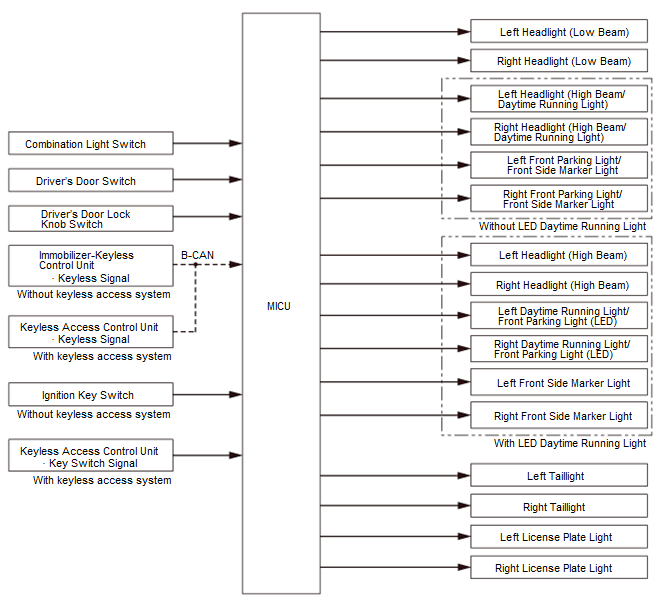
Headlight auto-OFF function turns OFF the exterior lights when the vehicle is turned to OFF (LOCK) mode and the driver door is opened and then closed. Time for turning OFF the exterior lights can be set by the customizing function. The MICU energizes the headlight and parking lights based on input signals from the driver's door switch and driver's door lock knob switch after turn the vehicle OFF (LOCK) mode. The MICU control the headlight and parking lights signal output to cancel irrespective of combination light switch position.
Turn Signal/Hazard Light Function
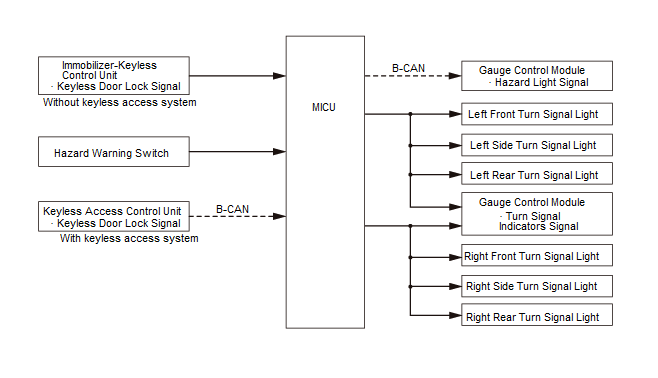
The turn signal/hazard warning lights are controlled by the MICU, using input from the combination switch or hazard warning switch signal. When the MICU sees a left turn or right turn command from the combination switch, it blinks the front and rear turn signal lights of the left or right side of the vehicle. When the MICU sees a hazard warning command from the hazard warning switch, it blinks the front and rear turn signal lights of both sides of the vehicle.
Disconnection Detection Function
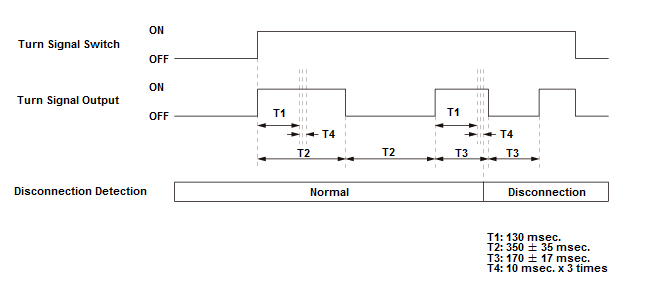
Disconnection detection is performed by monitoring current value of the turn signal lights. When the turn signal switch is turned to ON, the disconnection detection starts after 130 milliseconds, and then samples three times every 10 milliseconds. If the sampled value matches the disconnection detection value, interval of the turn signal output is changed.
One-Push Turn Signal Light
With the vehicle ON mode, when there is a brief input from the turn signal switch (from 40 ms to 1 second), the MICU flashes the left or right turn signal three times in succession.
Fog Light Function (For Some Models)
The fog light is controlled by the MICU, based on switch input from the combination light switch.
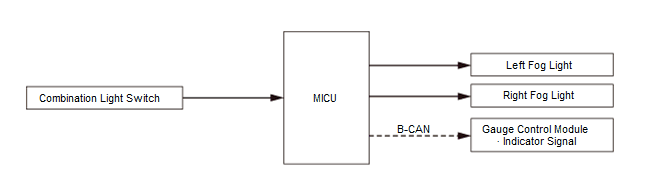
Daytime Running Lights Function (LED Type)
The daytime running lights are controlled by the MICU based on the combination light switch signal, the parking brake signal, and the automatic lighting signal. When the combination light switch is in the AUTO or the PARKING position at the time of the vehicle ON mode, and the parking brake switch is turned off, the MICU transmits an output signal to the daytime running light. When the combination light switch is in the ON position or the AUTO position, and the low beam output signal from the automatic lighting control unit is input to the MICU, the daytime running light control is not performed.
Daytime Running Lights Function (Headlight High Beam Type)
To control the daytime running lights, the MICU can provide power to the high beam based on inputs from the combination light switch signal, parking brake signal, and auto light signal. When on, the MICU provides reduced power to the high beam using duty control. With the vehicle ON mode, the parking brake switch OFF, and the combination light switch in the OFF or PARKING position, the MICU turns on the daytime running lights. With the vehicle ON mode, the parking brake switch OFF, and the combination light switch in the AUTO position, the MICU turns on the daytime running lights when the automatic lighting control system does NOT command the headlights ON. With the vehicle ON mode, the parking brake switch OFF, and the combination light switch in any position, the MICU will not turn on the daytime running lights. Once the parking brake is turned OFF (automatic lighting control system OFF), the MICU commands the daytime running lights ON. The daytime running lights will then remain ON regardless of the parking brake switch position, until the vehicle turned to the OFF (LOCK) mode.
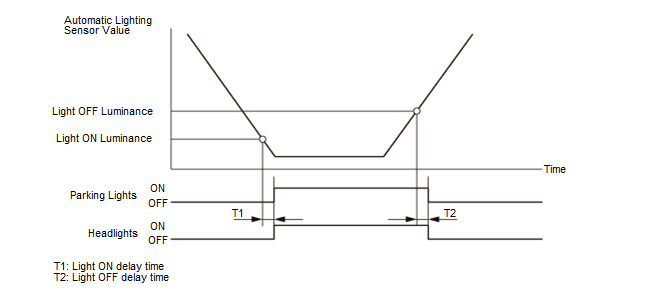
Automatic Lighting ON/OFF Control
The automatic lighting sensor output voltage reaches lighting delay time (about 1 second) after lighting illuminance from Off state, the parking lights, the taillights, the license plate lights and the headlights turn on. The automatic lighting sensor output voltage reaches turn off delay time (about 5 seconds) after off illuminance from lighting state, and the parking lights and the headlights turn off.
| Vehicle Model | Lights ON Delay Time | Lights OFF Delay Time |
|---|---|---|
| Type A* | 5 sec. | 5 sec. |
| Type B* | 1 sec. | 1 sec. (Vehicle speed is 1.8 mph (3 km/h) or less) |
| 5 sec. (Vehicle speed is 1.8 mph (3 km/h) or more) |
*: Control is different depending on the specifications.
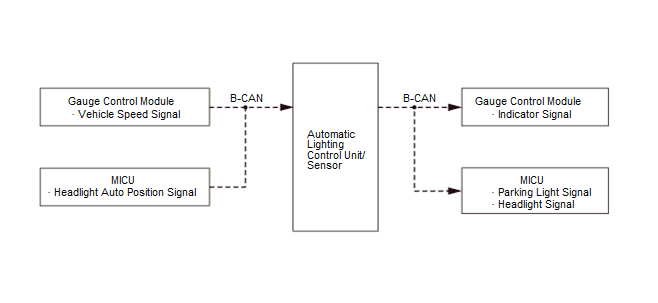
Without Automatic Wiper
With Automatic Wiper
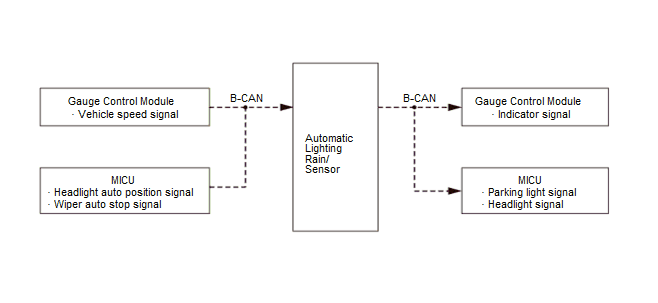
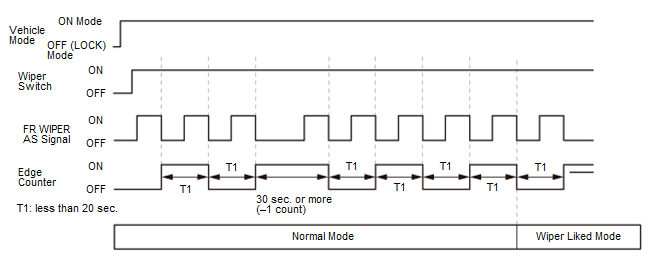
Wiper Linked Mode (With Automatic Wiper)
When the wiper switch is in a position other than OFF, the MICU counts and records the wiper motor ON to OFF signal (edge count) and the front wiper AS signal from the windshield wiper motor. A counting interval is less than 20 seconds. After a total of 5 counts, it switches to wiper linked mode and turns on the headlights, the parking lights, the taillights, and the side marker lights. The ON/OFF signals at the time of windshield washer operation are not counted. When an edge count is not received for 30 seconds or more, the count is reduced by 1, and shifting to normal mode is done when the count reaches 0. The wipers return to normal when the vehicle is stopped, or when the respective switch is set to OFF.
Warning Function
Without automatic wiper
The MICU sends an indicator signal to the gauge control module in case of failure that the automatic lighting sensor voltage value is abnormal.
With automatic wiper
The automatic lighting/rain sensor sends an indicator signal to the gauge control module in case of failure of the automatic lighting sensor or when the signal sent from the MICU by B-CAN signal is abnormal.
Interior Lights Brightness Change Control
Regardless of the combination light switch AUTO position, the MICU*1 or the automatic lighting/rain sensor*2 controls brightness for daytime or nighttime brightness. The MICU*1 or the automatic lighting/rain sensor*2 sends the signal to the gauge control module with the B-CAN.
*1: Without automatic wiper *2: With automatic wiper
Sensitivity Adjustment Function
Sensitivity adjustment function of automatic lighting system can be customized with the gauge control module. You can select the customized timing from five levels (Min, Lo, Mid, Hi, Max) of sensitivity.