Radiator and A/C Condenser Fan Low Speed Circuit Troubleshooting
NOTE:
- Do not use this troubleshooting procedure if the A/C compressor is inoperative. Refer to the symptom troubleshooting index - Refer to: Heating and A/C Systems Symptom Troubleshooting Index (Heating/Air Conditioning)Climate Control System Symptom Troubleshooting Index (Climate Control) .
- If A/C refrigerant pressure is abnormal, the radiator and A/C condenser fans are controlled based only on engine coolant temperature.
- Before doing symptom troubleshooting, check for PGM-FI DTCs - Refer to: How to Troubleshoot the Fuel and Emissions SystemsHow to Troubleshoot the CVT System (CVT System) .
- 1. Fuse check:
- 1. Check the following fuse.
Fuse No. A2-11 (20 A) Location Under-hood fuse/relay box Is the fuse OK?
YES
Go to step 2.
NO
Replace the fuse, and recheck. If the fuse blows again, repair a short in the No. A2-11 (20 A) fuse circuit.
- 2. PGM-FI system parameter check:
- 1. Connect the HDS to the DLC.
- 2. Turn the vehicle to the ON mode. Make sure the A/C system is OFF, then start the engine.
- 3. Turn the blower control dial ON, then momentarily turn ON the A/C with the A/C button.
NOTE: Do not run the A/C for more than a few seconds with the engine running or damage to the A/C system will result.
- 4. Check the parameter(s) below with the HDS.
Signal Threshold Current conditions Values Unit Values Unit FAN LOW CTRL ON Is the FAN LOW CTRL on with the A/C on?
YES
Go to step 3.
NO
Update the PCM if it does not have the latest software, or substitute a known-good PCM , and recheck.
- 3. Radiator fan and fan control relays check:
- 1. Turn the vehicle to the OFF (LOCK) mode.
- 2. Remove the radiator fan relay and fan control relay from the under-hood fuse/relay box, and test it .
Are the relays OK?
YES
Go to step 4.
NO
Replace the radiator fan relay and/or fan control relay.
- 4. Open wire check (+B MAIN FAN line):
- 1. Measure the voltage between test points 1 and 2.
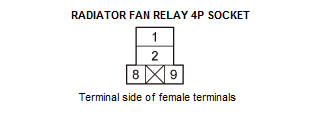
Test condition Vehicle OFF (LOCK) mode Radiator fan relay: disconnected Fan control relay: disconnected Test point 1 Radiator fan relay 4P socket No. 1 Test point 2 Body ground Is there battery voltage?
YES
The +B MAIN FAN wire is OK. Go to step 5.
NO
Repair an open in the wire between the No. A2-11 (20 A) fuse and the radiator fan relay in the under-hood fuse/relay box.
- 5. Determine possible failure area (radiator fan relay switch side circuit, radiator fan relay coil side circuit):
- 1. Reinstall the fan control relay.
- 2. Connect terminals A and B with a jumper wire.
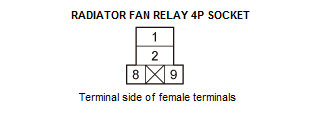
Terminal A Radiator fan relay 4P socket No. 1 Terminal B Radiator fan relay 4P socket No. 2 Do the A/C condenser and radiator fans run on low?
YES
Go to step 6.
NO
Go to step 8.
- 6. Open wire check (IG2 A/C line):
- 1. Disconnect the jumper wire.
- 2. Turn the vehicle to the ON mode.
- 3. Measure the voltage between test points 1 and 2.
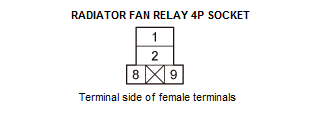
Test condition Vehicle ON mode Radiator fan relay: disconnected Test point 1 Radiator fan relay 4P socket No. 8 Test point 2 Body ground Is there battery voltage?
YES
The IG2 A/C wire is OK. Go to step 7.
NO
Repair an open in the wire between the No. B22 (7.5 A) fuse in the under-dash fuse/relay box and the radiator fan relay.
- 7. Open wire check (FAN LO SIGNAL line):
- 1. Turn the vehicle to the OFF (LOCK) mode.
- 2. Reinstall the radiator fan relay.
- 3. Jump the SCS line with the HDS, and wait more than 1 minute.
SCS Short
NOTE: This step must be done to protect the PCM from damage.
- 4. Disconnect the following connector.
PCM connector A (51P) - 5. Connect terminals A and B with a jumper wire.
Terminal A PCM connector A (51P) No. 9 Terminal B Body ground - 6. Turn the vehicle to the ON mode.
Does the A/C condenser fan (and radiator fan) run on low?
YES
Update the PCM if it does not have the latest software, or substitute a known-good PCM , and recheck.
NO
Repair an open in the wire between the radiator fan relay in the under-hood fuse/relay box and the PCM.
- 8. Open wire check (MAIN FAN MOTOR line):
- 1. Disconnect the following connector.
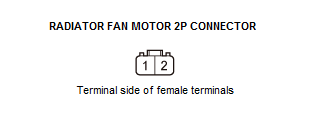
Radiator fan motor 2P connector - 2. Measure the voltage between test points 1 and 2.
Test condition Vehicle OFF (LOCK) mode Radiator fan motor 2P connector: disconnected Radiator fan relay: disconnected Radiator fan relay 4P socket No. 1 and No. 2: jumped Test point 1 Radiator fan motor 2P connector No. 1 Test point 2 Body ground Is there battery voltage?
YES
The MAIN FAN MOTOR wire is OK. Go to step 9.
NO
Repair an open in the wire between the radiator fan relay in the under-hood fuse/relay box and the radiator fan motor.
- 9. Radiator and A/C condenser fan motors test:
- 1. Test the radiator and the A/C condenser fan motors .
Are the radiator and A/C condenser fan motors OK?
YES
Go to step 10.
NO
- 10.Open wire check (FAN HI/LO RLY COM line):
- 1. Reconnect the radiator fan motor 2P connector.
- 2. Remove the fan control relay from the under-hood fuse/relay box.
- 3. Measure the voltage between test points 1 and 2.
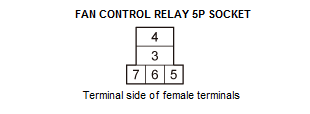
Test condition Vehicle OFF (LOCK) mode Radiator fan relay: disconnected Fan control relay: disconnected Radiator fan relay 4P socket No. 1 and No. 2: jumped Test point 1 Fan control relay 5P socket No. 4 Test point 2 Body ground Is there battery voltage?
YES
The FAN HI/LO RLY COM wire is OK. Go to step 11.
NO
Repair an open in the wire between the radiator fan motor and the fan control relay in the under-hood fuse/relay box.
- 11.Open wire check (SUB FAN MOTOR line):
- 1. Reinstall the fan control relay.
- 2. Disconnect the following connector.
A/C condenser motor 2P connector - 3. Measure the voltage between test points 1 and 2.
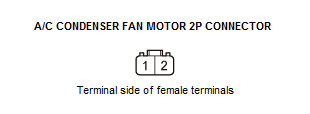
Test condition Vehicle OFF (LOCK) mode Radiator fan relay: disconnected A/C condenser fan motor 2P connector: disconnected Radiator fan relay 4P socket No. 1 and No. 2: jumped Test point 1 A/C condenser fan motor 2P connector No. 1 Test point 2 Body ground Is there battery voltage?
YES
Check for an open in the wire between the A/C condenser fan motor and body ground. If the wire is OK, check for poor ground at G302.
NO
Repair an open in the wire between the fan control relay in the under-hood fuse/relay box and the A/C condenser fan motor.