Braking Surface Inspection
HANDLING CERAMIC COMPOSITE MATERIAL (CCM) ROTORS
CCM rotors are made from a very hard material which is nonetheless fragile. Therefore, when replacing the rotors, it is necessary to pay attention and take care to handle them in the workshop protected by their packaging until they must be mounted on the vehicle.
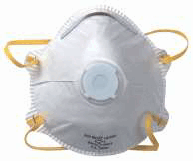
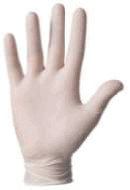
Moreover, the presence of carbon fiber immersed in a ceramic matrix can produce dust (carbon) that is deposited on the pads and the rotor's surfaces. This dust can also cause skin irritation, redness and burns. In order to avoid damaging the health of the mechanics, they must use appropriate personal protection equipment:
INSPECTION TO CHECK CCM ROTOR INTEGRITY AND WEAR
Deterioration of the braking surface causes two types of rotor wear:
- Thermal wear When the rotor reaches high temperatures, (especially when racing) the fibers on the braking surfaces start to oxidize. The level of surface oxidization can be seen from the porosity and roughness of the rotor's braking surface. The main effect of oxidization is a loss of the rotor's weight.
- Mechanical wear The mechanical action of the calipers on the rotor's surface reduces its thickness.
The overall wear is the result of the combination of the two types of wear described above. Which one dominates over the other depends only on the driving profile.
The rotor's surface degradation (mechanical or thermal) heavily influences the NVH* (Noise Vibration Harshness) index and the rotor's performance.
*The NVH index is the parameter that expresses the vehicle's comfort level. This parameter takes account of the vehicle's noise while driving, the vibrations felt by the driver and the roughness of the vehicle during sudden changes in motion (for example, holes in the ground)
Rotor wear is also related to the type of pad (material) used. In particular:
- With organic pads: only thermal wear.
- With Non-organic pads: thermal wear and mechanical wear.
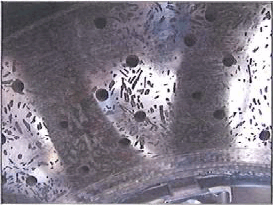
As an example, here are some images related to the state of wear of rotors used with organic and non-organic pads.
Wear with organic pads
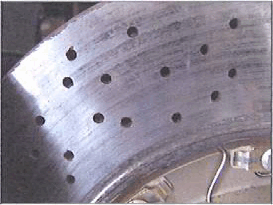
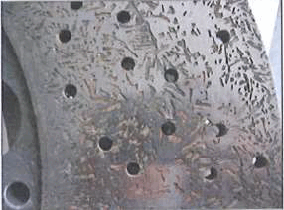
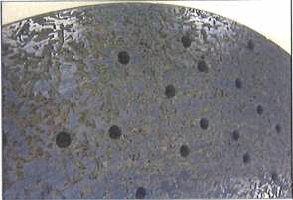
In need of replacement
Wear with non-organic pads
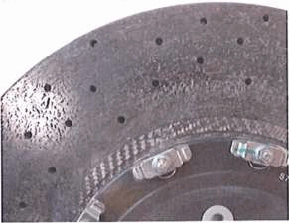
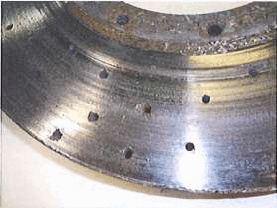
In need of replacement.
Another phenomenon of poor integrity that must be checked when visually inspecting the CCM rotor, is chipping on the outside edges of the rotor's surface and on the edges of the ventilation holes.
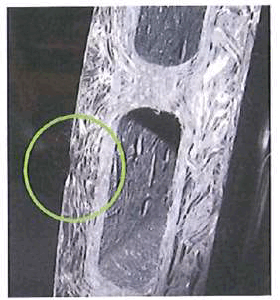
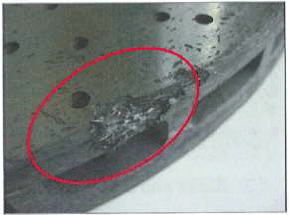
Generally, to assess if chipping is acceptable or not, you need to measure the width and depth of the chip
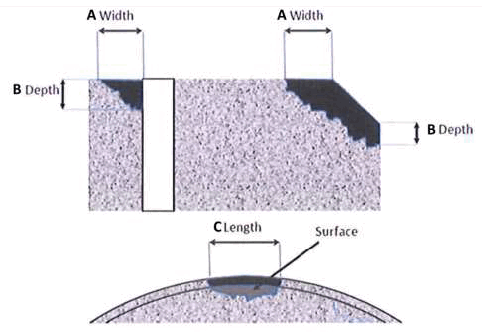
The maximum width "A" allowed is 4 mm (0.16 in.)
The maximum depth "B" allowed is 4 mm (0.16 in.)
The maximum length "C" allowed is 20 mm (0.79 in.)
Moreover, more than three chips along the rotor's outer edge is not acceptable. The maximum acceptable chip surface is 40 mm2 (0.06 in2 ).
Replacing CCM rotors
After replacing a CCM rotor, it is necessary to measure the axial eccentricity of the rotor and hub assembly. An eccentricity of more than 0.10 mm (0.0039 in.) is not allowed
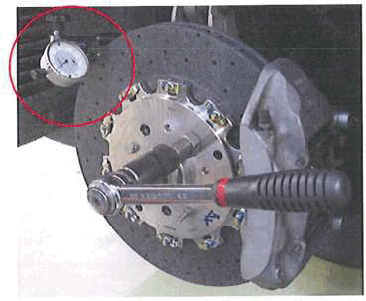
If the maximum value is greater than the accepted limit, the hub eccentricity must be measured.
The correct eccentricity value is vital for braking stability. High eccentricity values cause abnormal wear and strong vibrations.