Description And Operation
DESCRIPTION
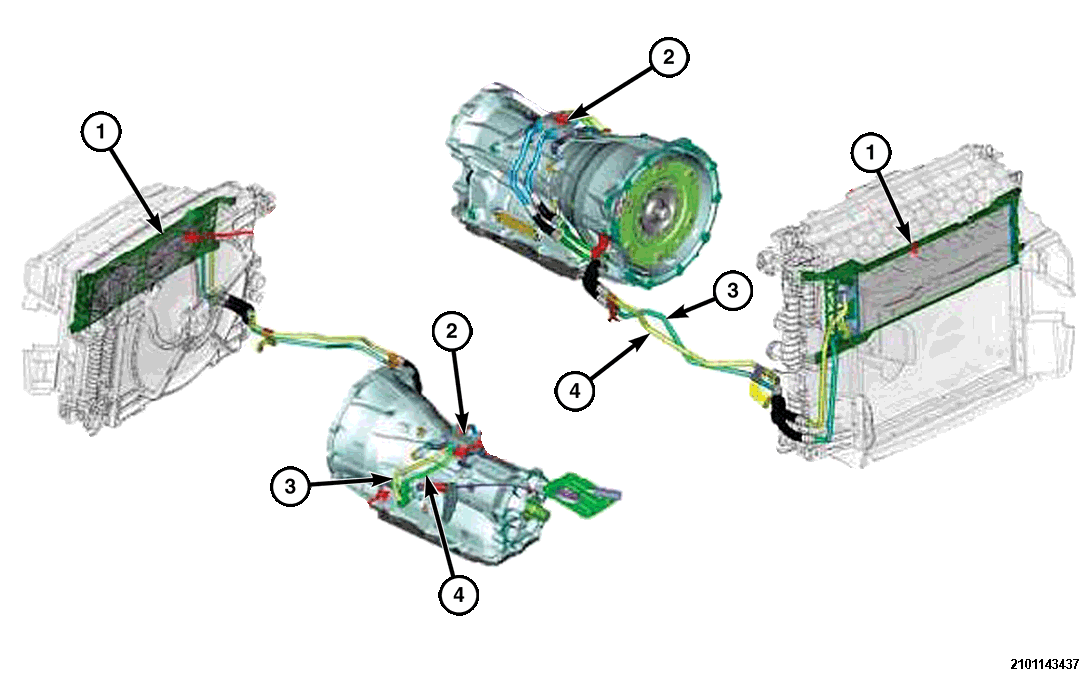
The transmission oil and heating system for base versions consists of the following components:
- Transmission oil cooler.
- Thermostatic bypass valve.
- Fluid recovery line.
- Fluid supply line.
The thermostatic bypass valve prevent the transmission oil from passing inside the heat exchanger when the oil temperature is lower than 71° C (160° F)
On the left side of the transmission housing there are:
- Two fittings for the cooling circuit.
- Thermostatic valve.
- Transmission oil cooler.
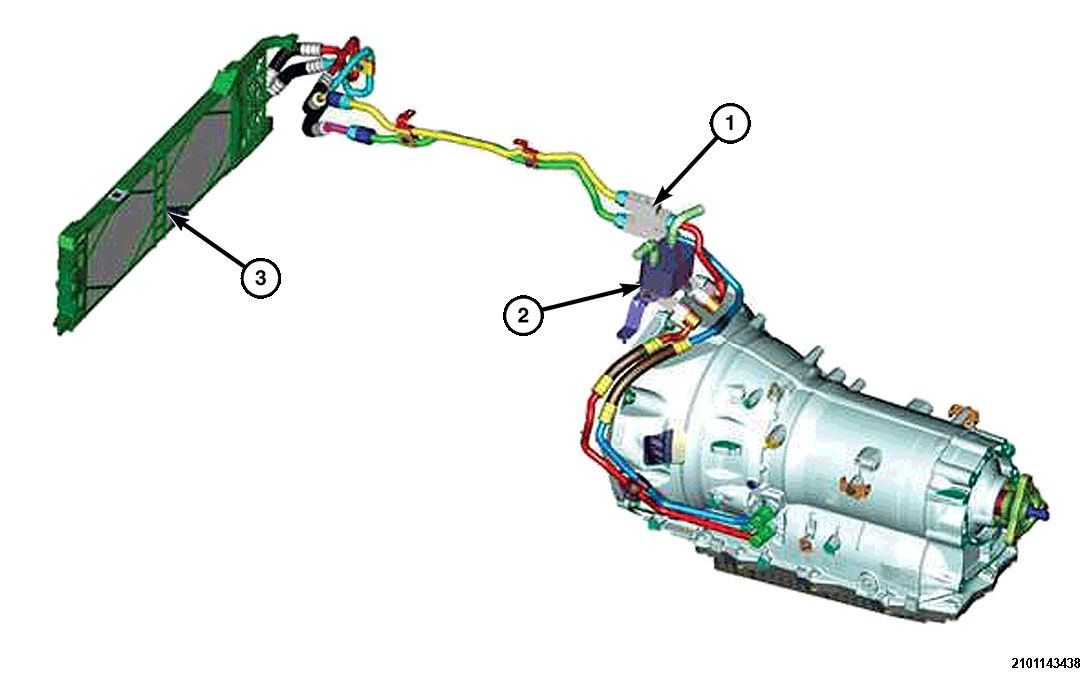
The transmission oil and heating system for 2.9L V6 versions consists of the following components:
- Bypass valve.
- Heat exchanger.
- Transmission oil cooler.
The thermostatic bypass vale opens partially at 75° C (167° F) and fully at 78° C (172° F).
OPERATION
Thanks to the thermostatic bypass valve, the air to oil cooling radiator only starts operating when the transmission oil temperature exceeds a certain limit. This allows the transmission oil to heat up to improve fuel consumption while maintaining the temperature within thresholds established by the supplier.
There are two different scenarios depending on oil temperature:
- If the transmission oil is below 75° C (167° F), the transmission fluid is heated by the engine coolant and then returned to the transmission.
- If the transmission oil is above 75° C (167° F), the transmission is cooled by the transmission oil cooler and then returned to the transmission. At high temperatures the fluid is also cooled by the engine coolant that passes through the heat exchanger.