Transmission Shifter
DESCRIPTION
A significant innovation is represented by the shift-by-wire shift engagement control, which means:
- There is no mechanical connection between the transmission and the shift lever.
- The shift lever is a device that detects the driver's requests.
- There is no mechanical backup.
- The hydraulically actuated parking lock is managed by the Transmission Control Module (TCM).
- There is always a backup device for manually unlocking it so that the vehicle can be moved if necessary.
Using a shift-by-wire device simplifies the control installation and assembly, improving the passenger compartment sound proofing thanks to the lack of connection cables between the transmission and the shift lever.
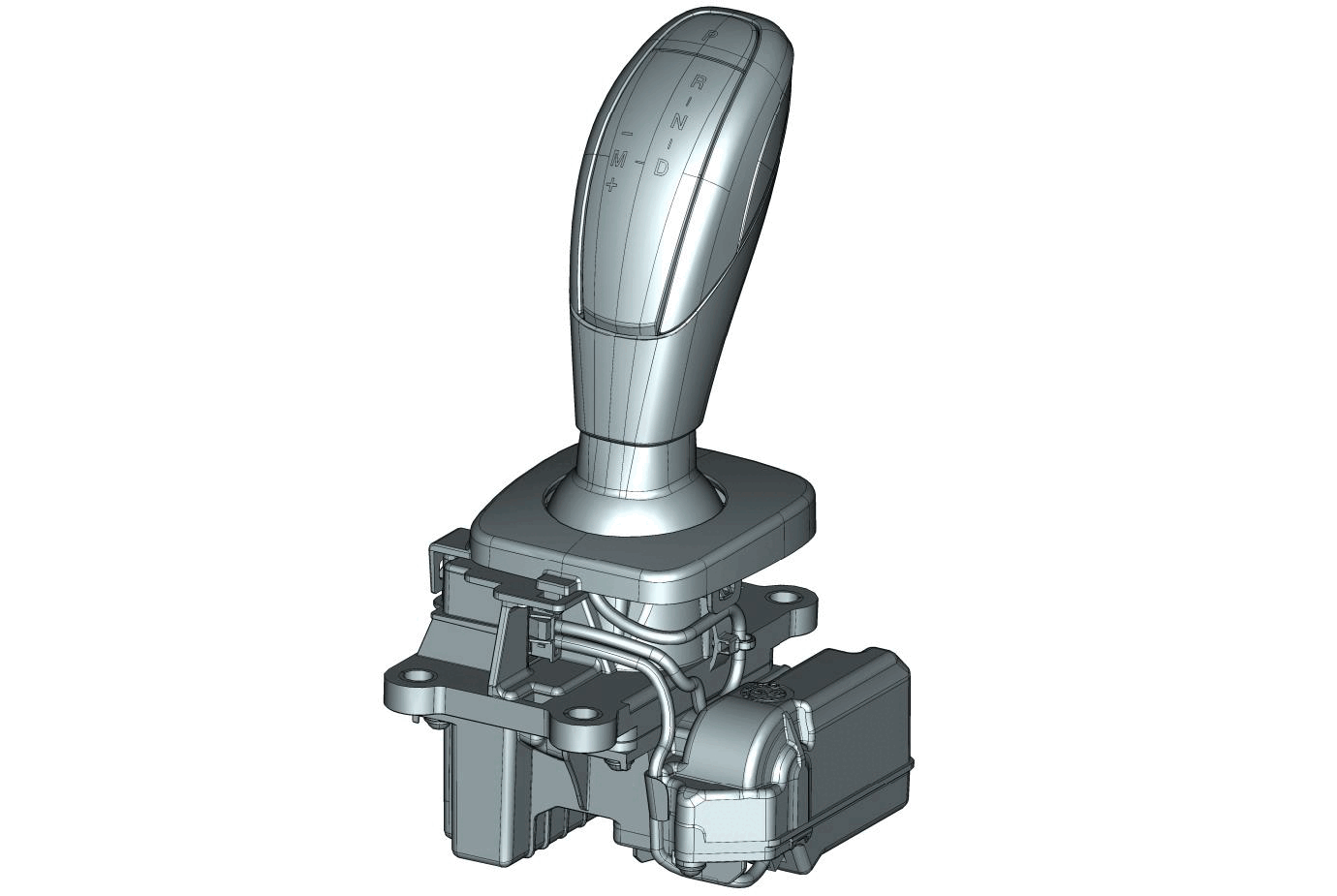
The transmission control consists of the shift lever and the Automatic Gearbox Shifter Module (AGSM). The TCM and AGSM both communicate on the Controlled Area Network (CAN) bus.
OPERATION
With the shift-by-wire technology the shift lever is no longer forced to follow a selection grid to achieve a given transmission condition but, not unlike a joystick, always returns to the starting position, named "Central Position". This behavior means that the shift lever position and the gearbox condition no longer correspond. To allow the shift control to be used intuitively, a logical control system that refers to the classic R, N, D, TIP selection grid was developed. From the Central Position the shift lever may move at most two positions forwards and at most two positions backwards. The shift lever has an ergonomic design and it has three key elements built into the top for gear shift management and driver information:
- Lever release button.
- Parking lock release button.
- Transmission gear indicator.
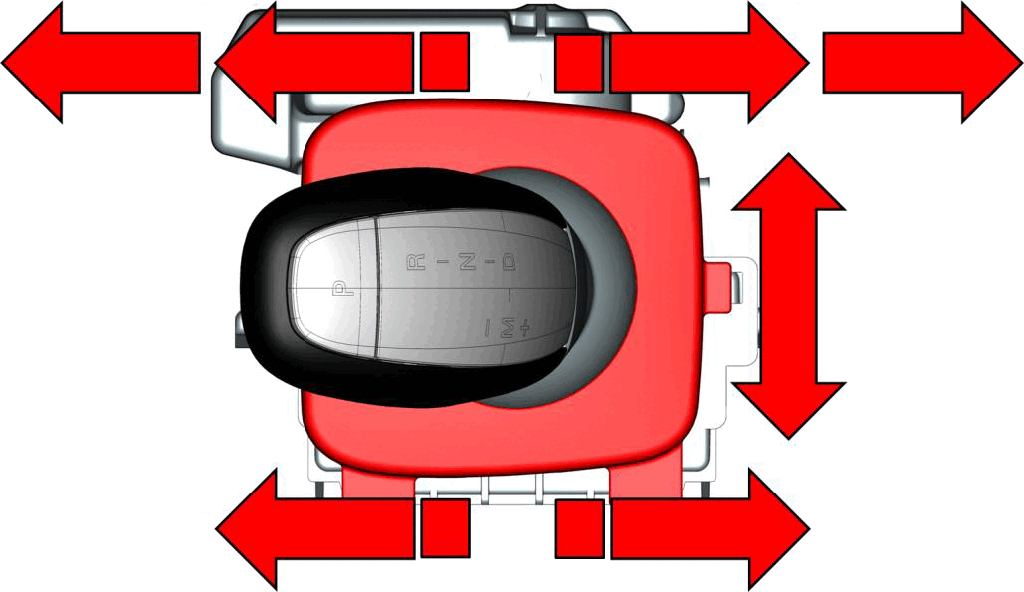
For the following shifts, you must press the brake pedal and/or the release button:
- From P to D: Brake pedal + lever release button.
- From D to R: Brake pedal + lever release button.
- From R to P: Brake pedal + parking lock engagement button.
- From N to D: Brake pedal.
- From N to R: Brake pedal + lever release button.
- From D to N: Movement allowed without any additional operations.
For safety reasons, between the speeds of 2.5 km/h to 5 km/h (1.5 mph to 3 mph), it is possible to shift from R to D and vice versa without pressing the brake pedal. The D or R icon will start to flash and the gear will be engaged as soon as the vehicle speed is below the threshold of approximately 2.5 km/h (1.5 mph).
Autostick - TIP Sequential manual shift mode
PADDLE SHIFTERS
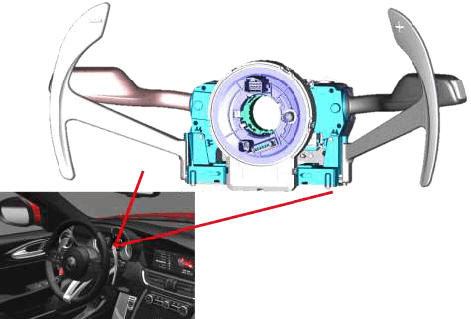
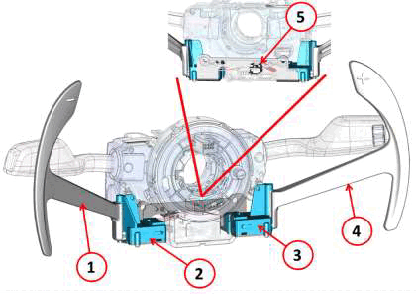
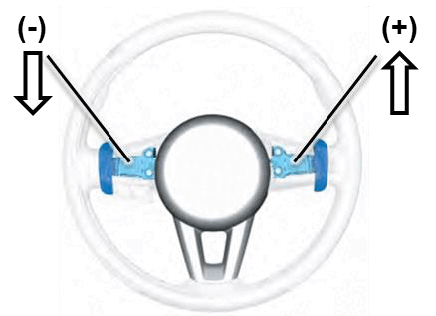
The vehicle may be equipped with shift paddles on the steering wheel. The paddles are mounted behind the steering wheel and allow the desired gear to be selected when driving in autostick (manual shift) mode by pulling the right paddle (+) towards the steering wheel and releasing it to shift up, or performing the same operation with the left paddle (-) to shift down The paddle control is built into the steering column switch electronic unit. When a gear shift is requested by closing the switch, the information is sent to the TCM.
- Left Paddle
- Left Switch
- Right Switch
- Right Paddle
- Shift Paddle Switch Connector
To activate manual shifting, put the lever to the D mode and move it to the left (- and + indications on the shifter). Each forward or backward movement of the lever corresponds to a gear shift request. The AGSM sends the shift message to the TCM and if the engine load, vehicle speed, etc. permit, the TSM will engage the requested gear. The instrument panel display will show the gear. If the engine is turned off with the lever in the TIP position, an electric actuator is controlled by the AGSM to move the lever to the D position and the TCM automatically engages the parking lock.
The vehicle may be equipped with shift paddles. The paddles are mounted behind the steering wheel and allow the desired gear to be selected when driving in autostick (manual shift) mode by pulling the right paddle (+) towards the steering wheel and releasing it to shift up, or performing the same operation with the left paddle (-) to shift down.
To engage N (Neutral): pull both paddles simultaneously. To activate D (Drive) mode, from N (Neutral), P (Parking) and R (Reverse): push the brake pedal and the right paddle (+).
The paddle control is built into the steering column switch electronic unit. When a gear shift is requested by closing the switch, the information is sent to the TCM.