Description And Operation
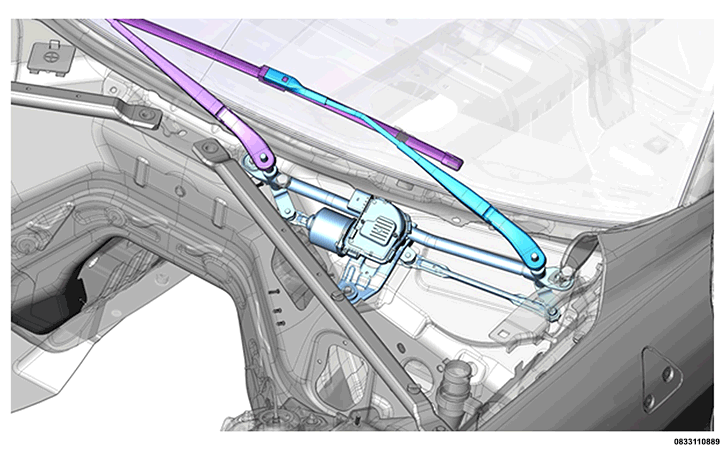
The windshield wiper mechanism is located behind the cowl trim, just below the windshield.
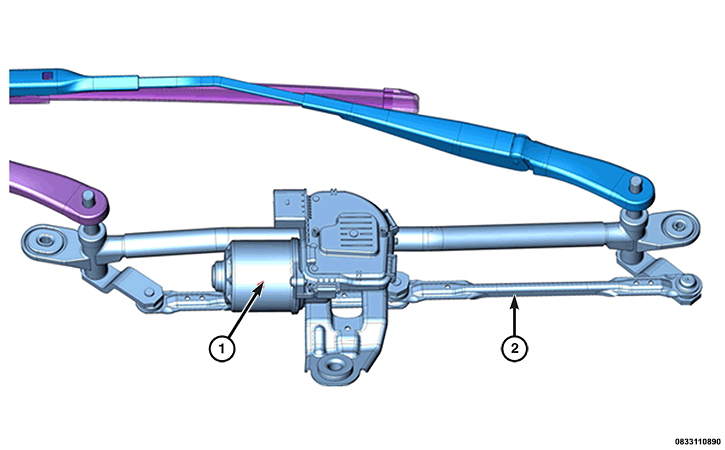
The windshield wiper mechanism consists of a Local Interface Network (LIN) bus controlled electric motor (1) which operates the control linkage (2) of the two arms, to which the rest of the wiper linkage and wiper blades are connected.
| 1 | LIN bus controlled electric motor |
| 2 | Control linkage |
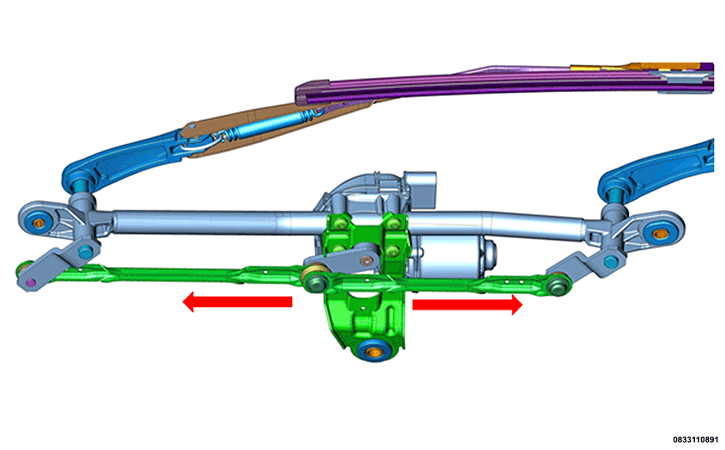
The feature of the electric motor is that it is controlled by electronics which can reverse the control linkage movement. In traditional windshield wiper mechanisms, the electric motor always turns the same way. The motion of the two blades is obtained by means of a cam present in the control mechanism.
In this case, the next-generation electric motor has a mechanism which does not always turn in the same direction but which cyclically reverses the sense of rotation without needing the motion inversion cam fitted in traditional mechanisms.
The main advantages of the system are:
- The blades are nearly invisible to the vehicle occupants when the blades are in home position.
- Larger wiping area. The system allows to set the motion inversion point very close to the A pillar of the windshield.
- Lighter weight of the system as a whole.
- Continuously controlled operating speed maintained in load conditions (wind force, variable friction).
Substantially, the electronics integrated in the motor can recognize the position of the arms instant by instant which allows to adjust the rotation speed of the motor according to their position. When the blade approaches the motor inversion point, the rotation speed of the motor is reduced: this causes reduction of noise and less consumption of the blade.
The electronics integrated in the motor can detect the presence of obstacles to arm movement (e.g. snow). An obstacle causes a higher current consumption. The system reduces the operating field of the arms to prevent damage when the current peak is detected.
The Body Control Module (BCM) manages motor activation by means of a dedicated LIN bus.