Description And Operation
DESCRIPTION
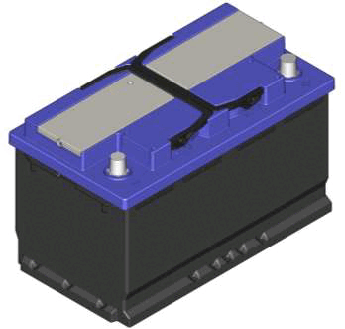
There are two battery types equipped according to destination market:
- 12v 80AH 680A - non cold countries
- 12v 95AH 800A - cold countries
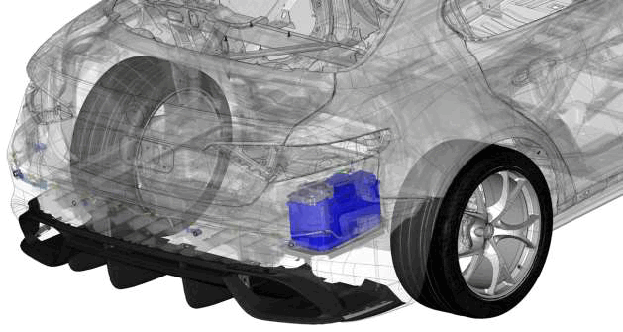
The battery is located in the center of the luggage compartment. A pyrotechnic fuse is present on the Battery Distribution Unit (BDU).
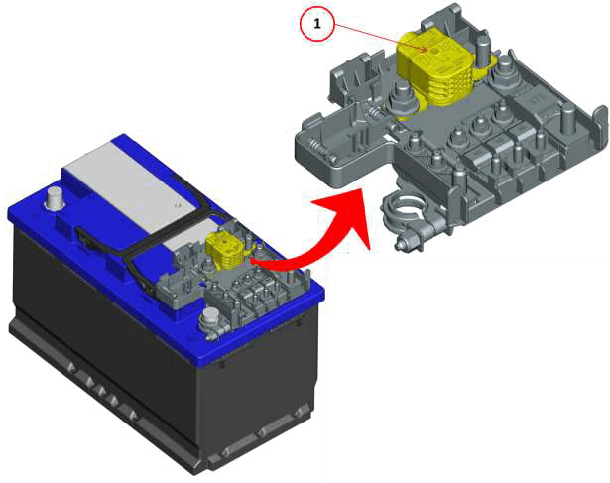
Electric energy is distributed to the Power Distribution Centers (PDC) positioned throughout the vehicle via the pyrotechnic fuse on the BDU. The BDU contains four additional fuses (two 40A fuses, one 30A fuse and one 175A fuse). A pyrotechnic fuse which cuts off the electric circuit supplying the front part of the vehicle is present on the BDU. In case of collision, the ORC controls the activation of the charge contained in the fuse. The gas pressure moves a ball, which breaks the metal foil to which the wiring is connected.
The fuses located on the BDU are:
- Rear PDC (175A)
- Body Control Module (BCM)1 (40A)
- BCM2 (40A)
- Intelligent Battery System (IBS) 30A
- Occupant Restraint Controller (ORC) pyrotechnic fuse (1)
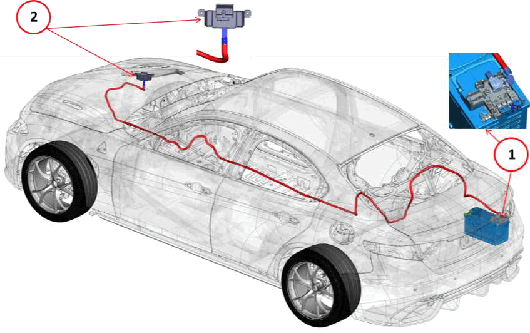
- Battery (1)
- Front PDC (2)
OPERATION
The battery is designed to store electrical energy in a chemical form. When an electrical load is applied to the terminals of the battery, an electrochemical reaction occurs. This reaction causes the battery to discharge electrical current from its terminals. As the battery discharges, a gradual chemical change takes place within each cell. The sulfuric acid in the electrolyte combines with the plate materials, causing both plates to slowly change to lead sulfate. At the same time, oxygen from the positive plate material combines with hydrogen from the sulfuric acid, causing the electrolyte to become mainly water. The chemical changes within the battery are caused by the movement of excess or free electrons between the positive and negative plate groups. This movement of electrons produces a flow of electrical current through the load device attached to the battery terminals.
As the plate materials become more similar chemically, and the electrolyte becomes less acid, the voltage potential of each cell is reduced. However, by charging the battery with a voltage higher than that of the battery itself, the battery discharging process is reversed. Charging the battery gradually changes the sulfated lead plates back into sponge lead and lead dioxide, and the water back into sulfuric acid. This action restores the difference in the electron charges deposited on the plates, and the voltage potential of the battery cells. For a battery to remain useful, it must be able to produce high-amperage current over an extended period. A battery must also be able to accept a charge, so that its voltage potential may be restored.
The battery is vented to release excess hydrogen gas that is created when the battery is being charged or discharged. However, even with these vents, hydrogen gas can collect in or around the battery. If hydrogen gas is exposed to flame or sparks, it may ignite. If the electrolyte level is low, the battery may arc internally and explode. If the battery is equipped with removable cell caps, add distilled water whenever the electrolyte level is below the top of the plates. If the battery cell caps cannot be removed, the battery must be replaced if the electrolyte level becomes low.