Description And Operation
DESCRIPTION
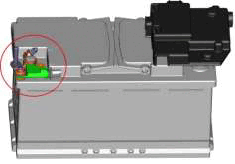
The Intelligent Battery Sensor (IBS):
- Is packaged on the negative battery post.
- Is a device used to measure battery current, voltage, and temperature.
- Sends calculated battery health status to the Body Control Module (BCM) via Local Interface Network (LIN) bus.
The signals from the IBS will be used in the energy management strategy.
The IBS:
- Does not have a direct diagnostic interface.
- Must be diagnosed through its LIN master node, the BCM - any IBS faults will be present in the BCM.
OPERATION
The IBS contains a low value resistor, or shunt. The shunt creates voltage drop, which is read by an internal microcontroller to determine the current flow in and out of the battery. In addition to the shunt, the IBS contains a sensor to monitor the battery's temperature. Data gathered by the IBS, including temperature, voltage, and current measurements, are transmitted over a communication bus to either the Body Control Module (BCM) or the Powertrain Control Module (PCM), depending on the application. The IBS serves two primary purposes. The first is to provide the PCM with both immediate and historical battery information, so the PCM can precisely control the charging system. The second purpose is to provide data to the BCM for operation of the load-shedding feature. A fused power circuit and the bus are connected to the IBS though a two-terminal connector.
In addition to real-time measurements, the IBS transmits some calculated battery data over the bus, including state of charge, state of health, and state of function. These values are calculated by storing measurements over time.
The battery sensor is readable/diagnosable via a "scan tool" that can display all of the available parameters needed for vehicle servicing or trouble shooting.
Information the IBS transmits out on the Controller Area Network (CAN) data bus is:
- SOC = Battery state of charge (SOC) is expressed as a percentage. The IBS calculates the SOC based on measured voltage, and charge and discharge rates. Therefore, SOC is not a direct percentage of battery voltage.
- SOF = Battery State of Function: Battery state of function (SOF) is a calculated prediction of the lowest voltage the battery will drop to during engine cranking.
The PCM and BCM use this calculated information to optimize vehicle power management for increased fuel efficiency. The data transmitted from IBS is interpreted and sent over the CAN data bus by the module connected to the IBS LIN bus.
When the IBS is powered up for the first time or is powered after a power disconnection, it enters a "recalibration" phase, where the IBS must recognize the type of battery and its characteristics and state. In this phase the tolerances on the state functions (SOC, SOF) are greater than in normal working condition. When IBS is disconnected from the battery, the device loses its stored memory. When power is restored, the IBS starts a relearn process. Until the relearn process is complete, accurate battery state information is unavailable to other vehicle systems. The IBS relearn process requires one start and at least 4 hours with the vehicle off, electrical system asleep. Remember, the relearn process is restarted every time power is reconnected to the IBS. This has a major effect on the stop/start feature.
If the IBS is damaged or ineffective, it cannot be serviced and must be replaced.