Rotor Weight - CCM
Checking the weight of the CCM rotor
The CCM carbon-ceramic rotor is a high-performance component and has a considerably longer lifetime for normal urban and extra-urban driving.
If the CCM rotor is subjected to high mechanical or thermal stresses (extended racing), oxidation may take place, causing a reduction in the rotor mass, and therefore in its weight. It is therefore recommended, for safety reasons, to weigh CCM rotors at regular intervals. In order not to alter the rotor weight, it should be cleaned completely before being weighed.
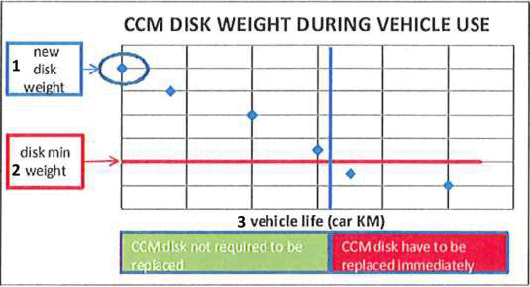
- Weight of a new CCM rotor
- Minimum allowed weight of a CCM rotor
- Life of the rotor expressed in Km
The CCM rotor must be replaced if its weight is the same or less than the minimum allowed weight. The minimum admissible weight value is engraved on the rotor bell itself. If one of the two rotors on the same axle reaches the minimum allowed weight, both rotors must be replaced.
Estimating the remaining life of a CCM rotor
The remaining life of each CCM rotor can be estimated by numerical interpolation based on their weights measured at regular intervals.
This method is based on determining the rotor life as the difference between:
- The rotor weight when new (rarely engraved on the rotor hat)
- The minimum allowable weight (always engraved on the rotor hat).
Rotor life (VD) = Weight of new rotor - Minimum allowed weight
The rotor remaining life is the difference between its current weight and the minimum allowed weight:
Rotor remaining life (VR) = Current weight of rotor - minimum allowed weight
The rotor "consumed" life is the difference between the weight of a new rotor and its current weight.
Rotor "consumed" life (VC) = Weight of new rotor - Current weight of rotor.
Through these three parameters, VD, VR and VC, it is possible to predict and estimate the rotor life in terms of Km before it reaches the minimum allowed weight engraved on the hat.
For this method to be reliable, the following two conditions must be met:
- Uniformity of the type of use (only racing or only road use)
- The weight and Km must be noted each time the check is done.
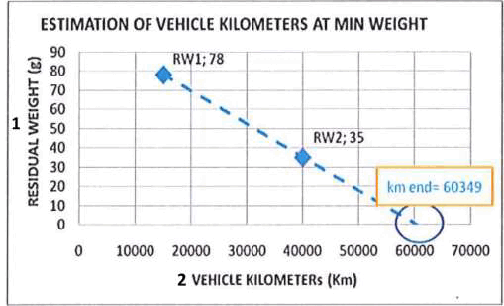
To give an example: Rotor life VD= 100g
| Check 1 | Km = 15, 000 | Remaining Life VR=78g | Consumed Life VC=22g (22%) |
| Check 2 | Km = 40, 000 | Remaining Life VR=35g | Consumed Life VC=65g (65%) |
By performing simple calculations, it is possible to estimate that the rotor life will expire at around 60, 000 Km.