Wipers/Washers (MICU) Input Test
NOTE:
- If you are troubleshooting multiple DTCs, be sure to follow the instructions in B-CAN System Diagnosis Test Mode A - Refer to: Body Electrical Troubleshooting - B-CAN System Diagnosis Test Mode A - Initial Communication and DTC ChecksBody Electrical Troubleshooting - B-CAN System Diagnosis Test Mode 1 and Test Mode 2 (without the HDS)Body Electrical Troubleshooting - B-CAN System Diagnosis Test Mode B - Control Unit Not CommunicatingBody Electrical Troubleshooting - B-CAN System Diagnosis Test Mode C - No DTCs and Output Won't Shut OFFBody Electrical Troubleshooting - B-CAN System Diagnosis Test Mode D - No DTCs and Output Won't Turn ON .
- Before testing, make sure the No. A2-9 (30 A) and No. A29 (10 A) fuses in the under-hood fuse/relay box are OK.
- Before testing, make sure the No. B13 (15 A), No. B23 (10 A), No. B28 (15 A)*1 and No. B36 (10 A)*2 fuses in the under-dash fuse/relay box are OK.
| *1: Without keyless access system *2: With keyless access system |
1. Turn the vehicle to the OFF (LOCK) mode
2. Disconnect the following connectors.
| Under-dash fuse/relay box connector B (44P) |
| Under-dash fuse/relay box connector C (38P) |
| Under-dash fuse/relay box connector D (32P) |
| Under-dash fuse/relay box connector P (20P) |
| Under-dash fuse/relay box connector R (8P) |
| Under-dash fuse/relay box connector T (20P) |
| Under-dash fuse/relay box connector W (24P) |
| Under-dash fuse/relay box connector X (10P) |
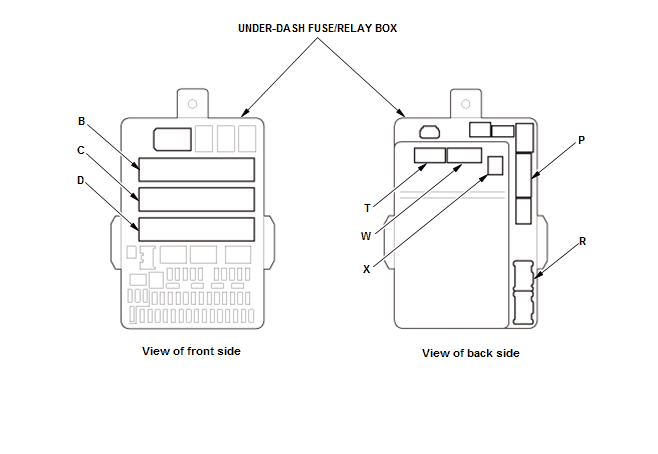
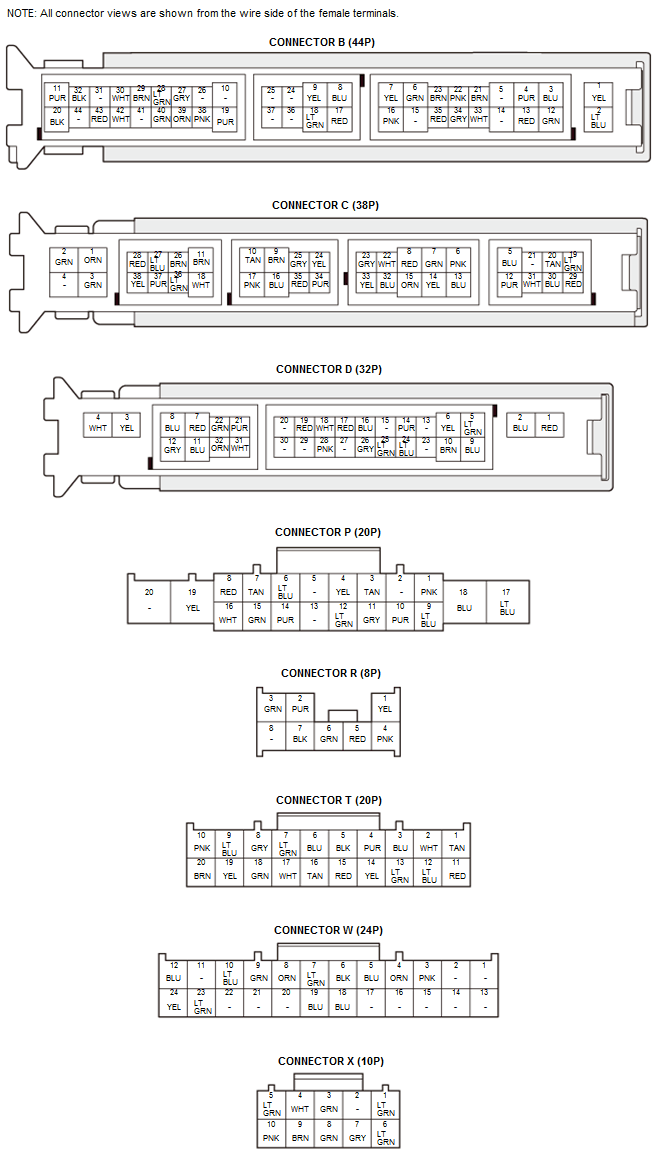
3. Inspect the connectors and socket terminals to be sure they are all making good contact:
- If the terminals are bent, loose, or corroded, repair them as necessary, and recheck the system.
- If the terminals are OK, go to step 4.
4. With the connectors still disconnected, do the following input tests:
- If any test indicates a problem, find and correct the cause, then recheck the system.
- If all the input tests prove OK, go to step 5.
| Cavity | Wire | Test condition | Test: Desired result | Possible cause if desired result is not obtained |
|---|---|---|---|---|
| C22 | WHT | Under all conditions | Connect terminals D3 and P9, and terminal C22 to body ground with jumper wires: The windshield wiper motor should run at high speed. |
|
| C32 | BLU | Run the windshield wiper motor by connect terminals D3 and P9, and terminal C22 to body ground with jumper wires. | Connect terminal C32 to body ground with a jumper wire: The windshield wiper motor speed should change from high speed to low speed. |
|
| C6.C15 | PNK.ORN | Under all conditions | Connect terminals C6 and D3, and terminal C15 to body ground with jumper wires: The windshield/rear window washer motor should run. |
|
| C23 | GRY | Run the windshield wiper motor by connecting terminals D3 and P9, and terminal C22 and body ground with jumper wires. | Use a DVOM to check for continuity to ground.NOTE: There is no needle on a DVOM. |
|
| P9*1 T20*1 | LT BLU.BRN | Under all conditions | Connect terminals D3 and P9, and terminal T20 to body ground with jumper wires: The rear window wiper motor should run. |
|
| B1*2 T20*2 | YEL.BRN | Under all conditions | Connect terminals D2 and B1, and terminal T20 to body ground with jumper wires: The rear window wiper motor should run. |
|
| T6.T15 | BLU.RED | Windshield wiper/washer switch (Intermittent dwell time controller) turned ON. | Measure the resistance between terminals T6 and T15: The resistance should vary between 0 to 1 kΩ. |
|
*1: Without keyless access system *2: With keyless access system
5. Reconnect the connectors to the under-dash fuse/relay box, and do the following input tests:
- If any test indicates a problem, find and correct the cause, then recheck the system.
- If all the input tests prove OK, the MICU must be faulty; replace the under-dash fuse/relay box .
| Cavity | Wire | Test condition | Test: Desired result | Possible cause if desired result is not obtained |
|---|---|---|---|---|
| D17 | RED | Under all conditions | Measure the voltage to ground: There should be battery voltage. |
|
| W6 | BLK | In all ignition switch positions or all power modes | Measure the voltage to ground: There should be less than 0.2 V. |
|
| B20 | BLK | In all ignition switch positions or all power modes | Measure the voltage to ground: There should be less than 0.2 V. |
|
| B32 | BLK | In all ignition switch positions or all power modes | Measure the voltage to ground: There should be less than 0.2 V. |
|
| D10 | BRN | In all ignition switch positions or all power modes | Measure the voltage to ground: There should be less than 0.2 V. |
|
| R7 | BLK | In all ignition switch positions or all power modes | Measure the voltage to ground: There should be less than 0.2 V. |
|
| C16 | BLU | Brake pedal pressed | Measure the voltage to ground: There should be battery voltage. |
|
| Brake pedal released | Measure the voltage to ground: There should be no voltage. |
|
||
| T15T16 | RED.TAN | Windshield wiper/washer switch (INT or LO) ON | Measure the voltage to ground: There should be less than 0.2 V. |
|
| Windshield wiper/washer switch OFF | Measure the voltage to ground: There should be about 5 V. |
|
||
| T15.T18 | RED.GRN | Windshield wiper/washer switch (MIST) ON | Measure the voltage to ground: There should be less than 0.2 V. |
|
| Windshield wiper/washer switch OFF | Measure the voltage to ground: There should be about 5 V. |
|
| Cavity | Wire | Test condition | Test: Desired result | Possible cause if desired result is not obtained |
|---|---|---|---|---|
| T15.T17 | RED.WHT | Windshield wiper/washer switch (LO or HI) ON | Measure the voltage to ground: There should be less than 0.2 V. |
|
| Windshield wiper/washer switch OFF | Measure the voltage to ground: There should be about 5 V. |
|
||
| T15.T19 | RED.YEL | Windshield washer switch ON | Measure the voltage to ground: There should be less than 0.2 V. |
|
| Windshield washer switch OFF | Measure the voltage to ground: There should be about 5 V. |
|
||
| T10.T15 | PNK.RED | Rear window wiper switch ON | Measure the voltage to ground: There should be less than 0.2 V. |
|
| Rear window wiper switch OFF | Measure the voltage to ground: There should be about 5 V. |
|
||
| T9.T15 | LT BLU.RED | Rear window wiper switch INT | Measure the voltage to ground: There should be less than 0.2 V. |
|
| Rear window wiper switch OFF | Measure the voltage to ground: There should be about 5 V. |
|
||
| T8.T15 | GRY.RED | Rear window washer switch ON | Measure the voltage to ground: There should be less than 0.2 V. |
|
| Rear window washer switch OFF | Measure the voltage to ground: There should be about 5 V. |
|
||
| D22 | GRN | Transmission range switch in P | Measure the voltage to ground: There should be less than 0.2 V. |
|
| Transmission range switch in any other position than P | Measure the voltage to ground: There should be about 5 V. |
|
| Cavity | Wire | Test condition | Test: Desired result | Possible cause if desired result is not obtained |
|---|---|---|---|---|
| D21 | PUR | Transmission range switch in R | Measure the voltage to ground: There should be less than 0.2 V. |
|
| Transmission range switch in any other position than R | Measure the voltage to ground: There should be about 5 V. |
|