Theory Of Operation
The Variable Valve Timing (VVT) system continuously varies the Camshaft target position based on the engine operating parameters. Based on these parameters, the Powertrain Control Module (PCM) calculates or models the optimum Camshaft position. The Camshaft angular position is varied by the Camshaft Oil Control Valve. The oil control valve directs oil pressure to a hydraulic actuator (phaser) on the Camshaft Sprocket to change the Camshaft position relative to the Crankshaft position. The PCM controls the Camshaft Oil Control Valve operation with a Low Side Driver (LSD) . The PCM performs fault detection on the driver circuit.
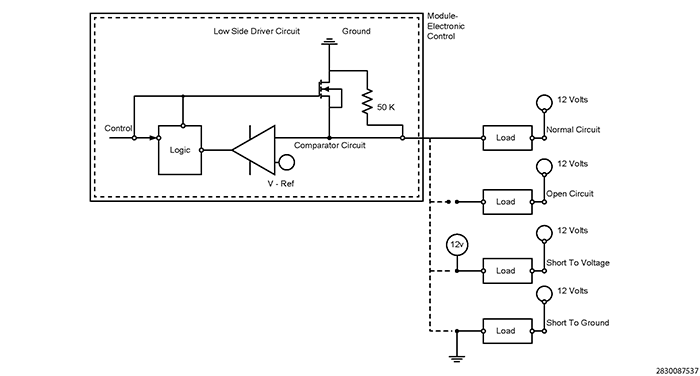
Typical Low Side Driver Operation and Fault Detection: This type of driver circuit is generally used for relay control, solenoid control or a similar type of driver device. The PCM provides a ground to operate the device when switched on. The ground could be constant or Pulse Width Modulated (PWM). The PCM also provides fault detection for the device, wiring and internal driver. Fault detection can be done by monitoring voltage on the circuit, current draw, or a combination of both. For diagnostic purposes the PCM uses an internal pull down diagnostic resistor connected in series and a voltage reference (V-Ref) comparator for fault detection:
- Circuit Open and Circuit Low Detection: The PCM monitors for an open circuit and short to ground when the driver is switched off. When switched off, the available voltage passes through the device and the internal pull down resistor connected in series. The voltage at the comparator circuit should be close to Battery voltage since the majority of the voltage drop occurs through the diagnostic resistor. If the available voltage is less than the V-Ref, a fault is set. In this scenario the V-Ref would be slightly below Battery voltage. An alternative method of fault detection for an open or short to ground that is used is to monitor current draw when the internal driver is switched on. If the module does not detect any current draw it determines that the component or circuitry is open. Excessive current draw detected would indicate a short to ground.
- Circuit High Detection: The PCM monitors for a short to voltage when the driver is switched on. When the driver is switched on providing a path to ground through the transistor, the available voltage should be pulled low, near zero volts since the comparator circuit is monitoring the ground side of the device. If the voltage is greater than V-Ref, a fault is detected. In this scenario V-Ref would be slightly above zero volts.
A load that has a resistance that is below manufacturer specification, or a second load device shorted to the low side driver circuit can cause excessive current draw on the internal driver. The driver will be switched off to protect against overheating and damaging the driver. In this instance the Circuit High fault may be detected because the available voltage on the comparator circuit is above V-Ref.
The PCM also performs VVT diagnostics to detect a Target Error and a Slow Response of the Camshaft, problems which could potentially increase tailpipe emissions. The Camshaft Position (CMP) Sensor is used for the VVT target error and slow response diagnostics. The diagnostic is primarily performed by comparing the actual Camshaft position to that of a calculated model for the Camshaft position. This diagnostic is continuous once the enable conditions are met, however the Slow Response and Target Error conditions are not performed simultaneously.
- The Target Error diagnostic evaluates the actual Camshaft position versus the modeled position when the Camshaft is in a relatively stable position. The difference between the two is considered to be the amount of "error". If the error amount is greater than a calibrated threshold, it is considered failing.
- The Slow Response diagnostic is only performed when the modeled Camshaft position is moving (phasing) in a particular direction, advancing or retarding. The modeled Camshaft phasing position is created to match only the worst possible case of a passing camshaft position. If the actual camshaft phasing operates slower than the model by a calibrated threshold, it is considered failing.
If either of these diagnostics fail, a fault is detected and the correlating DTC will set.